
Indian File - Iowa
1861/1869
Medium
oil on card mounted on paperboard
Dimensions
overall: 46.7 x 61.8 cm (18 3/8 x 24 5/16 in.)
Classification
Painting
Department
CAB
Museum
National Gallery of Art, Washington, D.C.
Credit
Paul Mellon Collection
Accession Number
1965.16.212
Rights
Public Domain
Art Historical Context
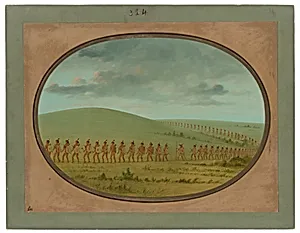
**Indian File - Iowa** by George Catlin captures a poignant moment of Native American life in the mid-19th century. Painted between 1861 and 1869, this oil on card mounted on paperboard (46.7 x 61.8 cm) depicts a line of figures traveling single file—likely members of the Iowa tribe or in Iowa territory—evoking the nomadic rhythms of Indigenous Plains cultures. Housed in the National Gallery of Art's Paul Mellon Collection, it exemplifies Catlin's lifelong dedication to documenting Native American ways before rapid Western expansion altered them forever. Catlin, a pioneering American artist active in the 1830s, journeyed extensively among tribes west of the Mississippi, creating thousands of sketches and paintings from life. Though executed later, *Indian File - Iowa* draws from his earlier observations, rendered in his characteristic realistic style influenced by Romanticism. The modest medium of oil on card—lightweight and portable—suggests it may have been a studio elaboration on field studies, allowing vivid details of clothing, posture, and landscape to shine through. This work holds cultural significance as a visual record of a vanishing world, highlighting the dignity and mobility of Native peoples amid encroaching settlement. Catlin's efforts preserve not just images, but a testament to America's diverse heritage, inviting viewers to reflect on history's complex tapestry.
About the Artist
George Catlin · 1796–1872
George Catlin (1796–1872), born in Wilkes-Barre, Pennsylvania, to Putnam Catlin and Polly Sutton—who had been captured by Native Americans during the 1778 Battle of Wyoming—initially pursued a legal career. Trained at Litchfield Law School, he was admitted to the bar in 1819 but abandoned law after two years to study art in Philadelphia in 1823. Self-taught as a portraitist, Catlin quickly gained ...