
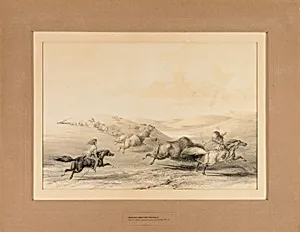
Indians Hunting Buffalo--no. 29
Medium
Graphic Arts-Print
Classification
Graphic Arts-Print
Department
Smithsonian Collection
Museum
Smithsonian American Art Museum
Credit
Smithsonian American Art Museum, Transfer from the National Museum of Natural History, Department of Ethnology, Smithsonian Institution
Accession Number
1985.66.386,590X
Rights
Public Domain
Tags
Art Historical Context
George Catlin's *Indians Hunting Buffalo--. 29* captures a thrilling moment from the lives of Plains Native American tribes, depicting equestrian hunters pursuing buffalo across a vast landscape. As part of Catlin's extensive series documenting Indigenous cultures, this graphic arts print—likely a reproduction of one of his original oil paintingsshowcases the artist's dedication to preserving scenes of traditional buffalo hunts, essential for food, clothing, and survivalIn the 19th century Catlin journeyed across the American West, sketching and painting over 600 works to record Native American customs before they were forever altered by westward expansion. These hunts, performed with remarkable skill on horseback, highlight the harmony between Indigenous peoples and their environment, as well as the buffalo's central role in Plains life. Held in the Smithsonian American Art Museum, transferred from the National Museum of Natural History's ethnology collection, the print underscores its value as both art and historical artifact. Catlin's realistic style, blending portraiture with dynamic action, influenced ethnographic art and brought these vivid narratives to wide audiences through affordable prints. Imagine the dust, thunder of hooves, and precision of the chase— a window into a world of cultural vitality now cherished in our collections.
About the Artist
George Catlin · 1796–1872
George Catlin (1796–1872), born in Wilkes-Barre, Pennsylvania, to Putnam Catlin and Polly Sutton—who had been captured by Native Americans during the 1778 Battle of Wyoming—initially pursued a legal career. Trained at Litchfield Law School, he was admitted to the bar in 1819 but abandoned law after two years to study art in Philadelphia in 1823. Self-taught as a portraitist, Catlin quickly gained ...