
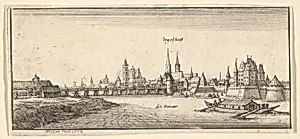
Ingolstadt, from "German Views"
Medium
Etching, only state
Dimensions
Plate: 2 × 4 1/2 in. (5.1 × 11.5 cm) cut on platemark
Classification
Prints
Department
Drawings and Prints
Museum
Metropolitan Museum of Art, New York, NY
Credit
Purchase, Joseph Pulitzer Bequest, 1917
Accession Number
17.50.17-404
Rights
Public Domain
Tags
Art Historical Context
Wenceslaus Hollar's *Ingolstadt, from "German Views"* (1665) captures the Bavarian city of Ingolstadt along the Danube River in a delicate etching, measuring just 2 × 4½ inches. This intimate print showcases boats gliding on water, sturdy bridges connecting riverbanks, and clustered buildings against the horizon—hall of a bustling 17-century European town. As of Hollar's series German landscapes, it reflects lifelong passion for topographical, honed during his travels Europe. A Bohemian master etcher (160–1677), Hollar was renowned for his extraordinary detail and precision, producing over 2,500 prints that preserved architecture and daily life with needle-like finesse. This etching, in its only state and cut on the platemark, exemplifies his Baroque-era technique: fine lines etched into copper plates create subtle textures, from rippling water to stone facades. Acquired by The Metropolitan Museum of Art in 1917 through the Joseph Pulitzer Bequest, it highlights Hollar's role in bridging Continental and English art worlds after his move to London. For visitors, this tiny gem offers a window into 17th-century Germany, evoking the era's engineering marvels like Ingolstadt's fortifications while celebrating printmaking's power to miniaturize grandeur. A testament to Hollar's eye for the everyday sublime.
About the Artist
Wenceslaus Hollar · 1607–1677
Wenceslaus Hollar (1607-1677) was a prolific Bohemian etcher who became one of the most accomplished printmakers of the seventeenth century. Born in Prague, he trained under Matthäus Merian in Frankfurt before entering the service of Thomas Howard, Earl of Arundel, in 1636. Hollar spent most of his career in England, where he produced approximately 2,740 etchings documenting an extraordinary range...