
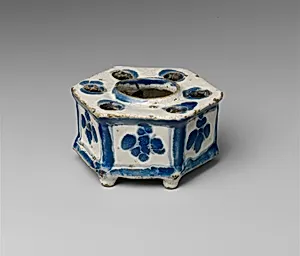
Inkwell
Unknown Artist
ca. 1750
Medium
Tin-glazed earthenware
Dimensions
Diam. 4 in. (10.2 cm)
Classification
Inkwell
Culture
Mexican
Department
The American Wing
Museum
Metropolitan Museum of Art, New York, NY
Credit
Gift of Mrs. Robert W. de Forest, 1911
Accession Number
11.87.19
Rights
Public Domain
Art Historical Context
This charming inkwell, crafted around 1750 in Mexico, exemplifies the vibrant tradition of tin-glazed earthen during the Spanish colonial era. Measuring just 4 inches in diameter, this compact utilitarian object would have served writers and scribes in households or offices, holding ink for quills amid the bustling trade and administration of New Spain. Its presence in The Metropolitan Museum of Art's American Wing highlights the interconnected worlds of colonial Americas, where Mexican ceramics influenced decorative arts across regions. The medium—tin-glazed earthenware, also known as majolica or talavera—is a hallmark of Mexican pottery. Artisans applied a tin-oxide glaze over fired earthenware clay, creating a smooth, opaque white surface ideal for bold painted designs in cobalt blue, yellow, and green. This technique, adapted from Islamic and European traditions via Spain, allowed for affordable yet decorative everyday wares, blending functionality with folk artistry. A gift to the Museum in 1911 from Mrs. Robert W. de Forest, this anonymous maker's piece offers a glimpse into 18th-century craftsmanship, evoking the lively markets of Puebla or Mexico City where such items were produced in workshops. Though modest in scale, it speaks volumes about cultural exchange and the enduring appeal of Mexican ceramics.