
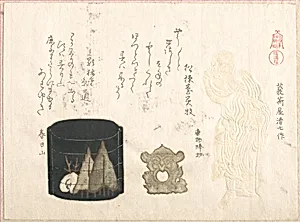
Inro and Two Netsuke
19th century
Medium
Woodblock print (surimono); ink and color on paper
Dimensions
5 3/8 x 7 1/4 in. (13.7 x 18.4 cm)
Classification
Prints
Culture & Period
Japan · Edo period (1615–1868)
Department
Asian Art
Museum
Metropolitan Museum of Art, New York, NY
Credit
H. O. Havemeyer Collection, Bequest of Mrs. H. O. Havemeyer, 1929
Accession Number
JP1988
Rights
Public Domain
Tags
Art Historical Context
Step into the refined world of Edo-period Japan with *Inro and Two Netsuke*, a delicate woodblock print (surimono) by Kubo Shunman from the 19th century. This intimate scene captures an *inro*—a lacquered, multi-tiered case worn suspended from a kimono sash to hold small essentials like medicines or seals—alongside two intricately carved *netsuke*, the toggles that secured it in place. Rendered in vibrant ink and color on paper (5 3/8 x 7 1/4 in.), the print showcases men's accessories as objects of exquisite craftsmanship, reflecting the era's fascination with functional beauty. Surimono, meaning "printed things," were privately commissioned luxury prints, often produced for New Year's greetings or poetry gatherings, distinguishing them from mass-market ukiyo-e with superior techniques like embossing, mica dusting, and precise color registration. Kubo Shunman, a versatile artist and poet active in the late Edo period (1615–1868), excelled in these bespoke works, blending realism with poetic elegance to celebrate everyday artistry. Housed in the Metropolitan Museum of Art's Asian Art department as part of the H. O. Havemeyer Collection (1929), this piece highlights Japan's material culture, where *netsuke* evolved into miniature sculptures prized by collectors worldwide. It invites visitors to appreciate how such humble items embodied status, ingenuity, and aesthetic harmony in samurai and merchant society.
About the Artist
Kubo Shunman · 1757–1820
Japanese, 1757–1820