
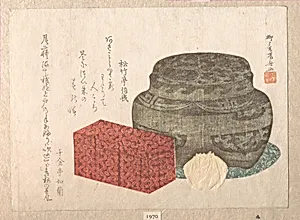
Fire-Holder and Tea-Box
19th century
Medium
Woodblock print (surimono); ink and color on paper
Dimensions
5 1/2 x 7 9/16 in. (14 x 19.2 cm)
Classification
Prints
Culture & Period
Japan · Edo period (1615–1868)
Department
Asian Art
Museum
Metropolitan Museum of Art, New York, NY
Credit
H. O. Havemeyer Collection, Bequest of Mrs. H. O. Havemeyer, 1929
Accession Number
JP1970
Rights
Public Domain
Art Historical Context
Nestled in the Metropolitan Museum of Art's Asian Art collection, *Fire-Holder and TeaBox* is a delicate 19th-century woodblock (surimono) by Ryūryūkyo Shinsai, a master of the ukiyo-e during Japan's Edo period (1615–1868). just 5½ x 7⁹/₁₆ inches, this intimate ink and color on paper work captures everyday objects—a fire-holder, likely a hand warmer, and a tea box—with exquisite precision and poetic elegance. Shinsai, known for his refined depictions of still lifes and nature, elevates these humble items into symbols of domestic tranquility and seasonal ritual. Surimono prints like this one were privately commissioned luxuries, often for New Year's greetings or poetry gatherings among literati. Unlike mass-produced ukiyo-e, they featured superior craftsmanship: vibrant colors layered meticulously, subtle embossing for texture, and sometimes mica for shimmer, all achieved through collaborative woodblock carving. This format highlights Edo Japan's vibrant print culture, where art bridged elite connoisseurship and popular aesthetics. Part of the esteemed H. O. Havemeyer Collection, bequeathed in 1929, the print invites us to savor the quiet beauty of Japanese material culture. Imagine tea ceremonies warmed by glowing embers—Shinsai's work whispers of mindfulness in a bustling world.
About the Artist
Ryūryūkyo Shinsai · 1799–1823
Ryūryūkyo Shinsai (柳々居辰斎), active from 1799 to 1823, was a prominent Japanese ukiyo-e printmaker based in Edo (modern Tokyo), renowned for his mastery of surimono—luxurious, privately commissioned woodblock prints produced for elite poetry circles and New Year's celebrations. He began his training under Tawaraya Sōri before becoming a student of the legendary Katsushika Hokusai, from whom he recei...