
Interior Column Capital from the Winston Block, Chicago, Illinois
1872 (demolished 1982)
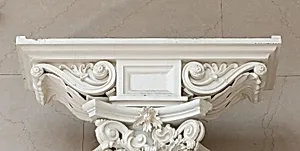
Medium
Painted cast iron
Dimensions
32 × 107 × 39 cm (12 5/8 × 42 3/16 × 15 3/8 in.)
Classification
architectural fragment
Department
Architecture and Design
Museum
Art Institute of Chicago
Accession Number
100247
Rights
Public Domain
Art Historical Context
Step into the opulent interiors of 19th-century Chicago with this intricately detailed column capital from the Winston Block, designed by architect Frederick H. Baumann in 1872. Crafted as painted cast iron, it measures a modest 32 × 107 × 39 cm, yet captures the grandeur of the era's commercial architecture. Baumann, a prominent Chicago practitioner, contributed to the city's post-Great Fire rebuilding boom, where innovative materials like cast iron enabled lighter, more ornate structures than traditional stone. Cast iron's significance lies in its versatility: molds allowed for elaborate, neoclassical motifs—think scrolling acanthus leaves and floral flourishes—replicated affordably at scale. Painted to mimic stone or bronze, this interior capital would have crowned slender columns supporting galleries or atriums in the Winston Block, a multi-story commercial building that buzzed with urban energy until its demolition in 1982. Today, preserved at the Art Institute of Chicago's Architecture and Design department, this fragment evokes Chicago's transformative "Iron Age" of architecture. It reminds us how industrial innovation fueled aesthetic ambition, bridging functionality and artistry in the birthplace of the skyscraper. A poignant survivor of urban change, it invites us to ponder the hidden splendor of lost landmarks.