
Isadora Duncan
c. 1925
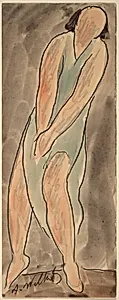
Medium
watercolor and graphite on wove paper
Dimensions
overall: 17.7 x 6.9 cm (6 15/16 x 2 11/16 in.)
Classification
Drawing
Department
CG-W
Museum
National Gallery of Art, Washington, D.C.
Credit
Gift of Jacob Kainen
Accession Number
2002.98.205
Rights
Public Domain
Art Historical Context
Abraham Walkowitz's *Isadora Duncan* (. 1925) is a delicate watercolor and graphite on wove paper, measuring just 17.7 x 6.9 cm. This intimate sketch captures the essence of the legendary modern dancer Isadora Duncan, whom Walkowitz obsessively portrayed in over 5,000 works throughout his career. As a pioneering figure in early 20th-century American, Walkowitz drew inspiration from Duncan's revolutionary free-form dancing, which rejected rigid ballet traditions in favor of expressive, natural movement influenced by ancient Greek ideals and nature. Created near the end of Duncan's life—she tragically died in 1927—this narrow, vertical composition likely evokes her dynamic energy through fluid lines and subtle color washes. The use of watercolor and graphite on wove paper allowed for spontaneous, translucent effects, mirroring the ephemeral quality of dance. Walkowitz's style, blending Post-Impressionist lyricism with modernist abstraction, transformed Duncan's performances into visual poetry, celebrating female emancipation and artistic freedom. Housed in the National Gallery of Art as a gift from Jacob Kainen, this drawing offers visitors a poignant glimpse into the cultural ferment of the 1920s, where dance and visual art converged to redefine modernism.
About the Artist
Abraham Walkowitz · 1880–1965
Abraham Walkowitz (1878–1965) was a Russian-born American artist who became one of the pioneering figures of modernist abstraction in the United States during the early twentieth century. Born in Tyumen, Siberia, he emigrated to New York as a child and later studied at the National Academy of Design. A transformative period in Paris around 1906–1907 exposed him to the Fauves, Cézanne, and the emer...