
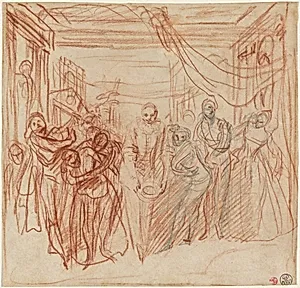
Italian Comedians Taking Their Bows
c. 1718
Medium
red chalk and graphite on cream laid paper
Dimensions
overall: 17.8 x 18.5 cm (7 x 7 5/16 in.)
Classification
Drawing
Department
CG-E
Museum
National Gallery of Art, Washington, D.C.
Credit
Gift of Gertrude Laughlin Chanler
Accession Number
2000.9.27
Rights
Public Domain
Art Historical Context
Antoine Watteau's *Italian Comedians Taking Bows* (c. 1718) is a delicate drawing that captures the graceful finale of a theatrical performance. Rendered in red chalk and graphite on cream laid paper, this intimate 17.8 x 18.5 cm sheet showcases performers mid-bow, their costumes flowing with Rococo elegance. As a master of the French Rococo style, Watteau frequently depicted the world of commedia dell'arte—Italian improvisational theater troupes popular in early 18th-century Paris—infusing his scenes with a bittersweet charm that blended fantasy and human emotion. This work exemplifies Watteau's extraordinary draftsmanship, a cornerstone of his legacy. Red chalk, or sanguine, lends a warm, fleshy glow to the figures, while graphite adds precise lines for costumes and expressions, creating depth in a modest scale. Likely a preparatory study, it reflects the Regency era's fascination with spectacle under Louis XV, where theater offered escapist delight amid social change. Watteau, who died young at 36, produced hundreds of such drawings, many more numerous and prized than his paintings. Today, this gem—gifted to the National Gallery of Art by Gertrude Laughlin Chanler—invites us to ponder the performers' poise and underlying melancholy, a hallmark of Watteau's vision. It's a window into the artistry behind the curtain, reminding visitors of drawing's power as both sketch and standalone masterpiece.
About the Artist
Antoine Watteau · 1684–1721
Jean-Antoine Watteau, born in 1684 in Valenciennes to a modest family—his father a roofer named Jean-Philippe Watteau—was the second of four sons who displayed an early passion for art. After initial apprenticeship under local painter Jacques-Albert Gérin, he moved to Paris around 1702, working in workshops copying Flemish and Dutch genre scenes. By 1705, he entered the studio of Claude Gillot, ab...