
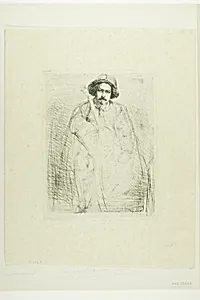
J. Becquet, Sculptor
Medium
Etching and drypoint with foul biting in black ink on cream Japanese paper
Dimensions
Plate: 25.5 × 19.3 cm (10 1/16 × 7 5/8 in.); Sheet: 40.9 × 32.5 cm (16 1/8 × 12 13/16 in.)
Classification
etching
Department
Prints and Drawings
Museum
Art Institute of Chicago
Accession Number
138000
Rights
Public Domain
Art Historical Context
In 1859, James McNeill Whistler, renowned American artist then living in Paris, created *J. Becquet, Sculptor*, a masterful etching capturing the French sculptor Jacques Becquet at work in his studio. This portrait reflects Whistler's early fascination with Realism, influenced by contemporaries like Gustave Courbet, and his deep engagement with Parisian artistic life during the late 1850s. Part of Whistler's celebrated "French Set" ofings, it showcases everyday creativity amid the bustling cultural scene of Second Empire France. Whistler's technique shines through in this etching and drypoint on cream Japanese paper, a nod to his growing interest in Eastern aesthetics. Etching involves acid "biting" into a metal plate to form precise lines, while drypoint adds rich, velvety burrs from direct needle scratches. The subtle "foul biting"—unintended acid corrosion—lends an atmospheric texture, enhancing the work's depth and spontaneity. Measuring a modest plate size of 25.5 × 19.3 cm, it exemplifies Whistler's precision in printmaking, bridging fine art and reproductive media. Housed in the Art Institute of Chicago's Prints and Drawings Department, this piece highlights Whistler's pivotal role in reviving etching as a serious artistic medium. Visitors will appreciate its blend of technical virtuosity and evocative portraiture, offering a window into 19th-century studio life.
About the Artist
James McNeill Whistler · 1834–1903
James Abbott McNeill Whistler (1834-1903) was an American-born painter and printmaker who became a leading figure in the Aesthetic Movement and pioneer of Tonalism and Japonisme. He revolutionized art by championing "art for art's sake" and treating paintings as visual equivalents of musical compositions, titling works as "arrangements," "harmonies," and "nocturnes" to emphasize formal qualities o...