
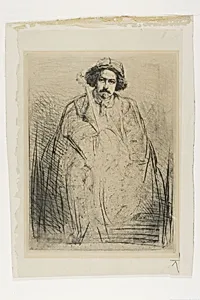
J. Becquet, Sculptor
Medium
Etching and drypoint with foul biting in black ink on ivory Japanese paper
Dimensions
Plate: 25.7 × 19.4 cm (10 1/8 × 7 11/16 in.); Sheet: 32 × 21.2 cm (12 5/8 × 8 3/8 in.)
Classification
etching
Department
Prints and Drawings
Museum
Art Institute of Chicago
Accession Number
79417
Rights
Public Domain
Art Historical Context
James McNeill Whistler’s *J. Becquet,or* (1859) captures the likeness of French sculptor Jacques Becquet in a striking portrait from Whistler’s acclaimed “French Set” of etchings. Created during the artist’s formative years in Paris, this work reflects Whistler’s immersion in the Realist circle, where he befriended fellow artists and drew inspiration from masters like Rembrandt. The intimate depiction of Becquet at work highlights Whistler’s early fascination with everyday creative life, bridging portraiture and the bohemian art world of mid-19th-century France. Masterfully executed in etching and drypoint with subtle foul biting—accidental corrosion that adds a textured, atmospheric grit—the print showcases Whistler’s technical prowess. Drypoint’s soft, velvety lines and the etching’s precise incisions create depth and immediacy on luxurious ivory Japanese paper, a nod to Whistler’s growing appreciation for Eastern aesthetics. This choice of medium elevated printmaking from reproductive tool to fine art, influencing the Aesthetic movement Whistler later championed. Housed in the Art Institute of Chicago’s Prints and Drawings department, this 25.7 × 19.4 cm plate exemplifies Whistler’s innovative approach, blending technical experimentation with portraiture’s psychological insight. Visitors will appreciate its raw energy and the glimpse into an artist’s evolution toward his signature harmony of tone and form.
About the Artist
James McNeill Whistler · 1834–1903
James Abbott McNeill Whistler (1834-1903) was an American-born painter and printmaker who became a leading figure in the Aesthetic Movement and pioneer of Tonalism and Japonisme. He revolutionized art by championing "art for art's sake" and treating paintings as visual equivalents of musical compositions, titling works as "arrangements," "harmonies," and "nocturnes" to emphasize formal qualities o...