
Jacket (suo) and trousers (nagabakama)
Unknown Artist
19th century
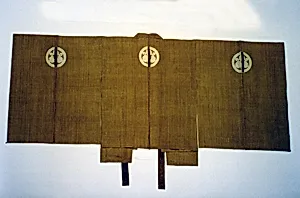
Medium
Resist-dyed hemp and ramie
Dimensions
Overall (a ): 38 1/4 x 69 5/8 in. (97.2 x 176.8 cm); b: 63 x 29 1/2 in. (160 x 74.9 cm)
Classification
Costumes
Culture
Japan
Department
Asian Art
Museum
Metropolitan Museum of Art, New York, NY
Credit
Gift of John B. Elliott through the Mercer Trust, 1999
Accession Number
1999.247.3a, b
Rights
Public Domain
Art Historical Context
This elegant 19th-century Japanese, consisting of a *suo* jacket and *nagabakama* trousers, offers a glimpse into traditional attire from the late Edo or early Meiji period. Crafted for comfort in Japan's humid summers, the *suo*—a lightweight, unlined jacket—and flowing *nagabakama* wide trousers were likely worn by nobility, performers, or during ceremonial occasions. Now housed in the Metropolitan Museum of Art's Art Department, this gift from John B. Elliott through the Mercer Trust highlights the refined craftsmanship of anonymous artisans. The garments are made from hemp and ramie, durable natural fibers prized for their breathability and strength in pre-industrial Japan. The standout feature is the resist-dyeing technique, where wax, stitches, or clamps block dye from certain areas, creating intricate patterns through subtle gradations and motifs. This labor-intensive method, akin to *shibori* or *kasuri*, exemplifies Japan's mastery of textile arts, transforming everyday fabrics into works of wearable poetry. Culturally, such costumes underscore Japan's deep integration of fashion, function, and aesthetics, influencing everything from theater to daily life. Visitors can appreciate how these pieces preserve the tactile beauty of hand-dyed traditions amid rapid modernization.