
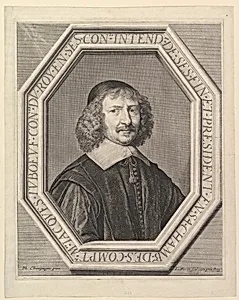
Jacques Tuboeuf, intendant des finances
Medium
Etching
Dimensions
sheet: 13 3/16 x 10 1/2 in. (33.5 x 26.6 cm) image: 11 1/2 x 9 1/4 in. (29.2 x 23.5 cm)
Classification
Prints
Department
Drawings and Prints
Museum
Metropolitan Museum of Art, New York, NY
Credit
Harris Brisbane Dick Fund, 1941
Accession Number
41.56.21
Rights
Public Domain
Tags
Art Historical Context
This elegant etching, *Jacques Tuboeuf,endant des finances*, captures dignified likeness of a prominent 17th-century French financial administrator. Created by master engraver Jean Morin after design by the renowned Baroque portraitist Philippe de Champa, it exemplifies the collaborative artistry of the era. Champaigne, a Flemish-born painter who became a leading figure in the French Royal Academy, was celebrated for his precise, psychologically penetrating portraits of nobility and officials. Morin, a skilled reproductive printmaker, faithfully translated Champaigne's vision into print, making elite imagery accessible beyond paintings. Etching, the medium here, was revolutionary in the 1600s for its fluid lines and rich tonal depths, achieved by coating a copper plate with acid-resistant ground, scratching designs, and immersing in acid to etch the lines. Measuring about 11½ x 9¼ inches, this intimate portrait highlights Tuboeuf's stern gaze and period attire, reflecting the administrative power structure under Louis XIII amid France's absolutist monarchy and Cardinal Richelieu's influence. Housed in the Metropolitan Museum of Art's Drawings and Prints department (Harris Brisbane Dick Fund, 1941), it offers a window into 17th-century bureaucracy and the rise of printmaking as a democratic art form, bridging courtly portraiture with wider audiences.
About the Artist
Jean Morin|Philippe de Champaigne · 1605–1650
Jean Morin (c. 1605–1650) was one of the most accomplished French engravers of the seventeenth century, a master of the portrait print whose work stands among the finest examples of French graphic art in its era. Little is known about his early life or training, though his technique suggests exposure to both French and Flemish engraving traditions, the latter being the dominant force in European p...