
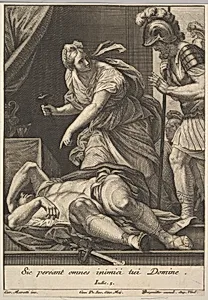
Jael slaying Sisera
Medium
Engraving and etching
Dimensions
sheet: 10 1/2 x 7 3/16 in. (26.6 x 18.3 cm) plate: 8 3/8 x 5 13/16 in. (21.2 x 14.8 cm)
Classification
Prints
Department
Drawings and Prints
Museum
Metropolitan Museum of Art, New York, NY
Credit
The Elisha Whittelsey Collection, The Elisha Whittelsey Fund, 1951
Accession Number
51.501.2613
Rights
Public Domain
Tags
Art Historical Context
This engraving and etching captures the dramatic biblical scene of Jael slaying Sisera, a powerful narrative of courage and divine justice drawn from the Book of Judges. The composition highlights the intense confrontation between the female protagonist and the defeated warrior, using expressive figures and dynamic poses to convey both tension and resolution. Created between 1705 and 1762, the print reflects the enduring popularity of Old Testament stories in European art during the Baroque and early Rococo periods. The work represents a collaboration between Italian painter Carlo Maratti, known for his refined classical style, and German artist Johann Georg Bergmüller. Their combined efforts resulted in a finely detailed print that blends Maratti’s compositional elegance with Bergmüller’s precise linework. The medium of engraving and etching allowed artists to achieve delicate shading and intricate textures, making such images widely accessible for study and devotion across Europe. Housed in the Metropolitan Museum of Art’s Department of Drawings and Prints, this sheet exemplifies how reproductive prints helped disseminate important religious and moral themes to broader audiences in the eighteenth century. Its modest scale and careful technique invite close viewing, rewarding visitors with subtle details of expression and form.
About the Artist
Carlo Maratti|Johann Georg Bergmüller · 1625–1713
Son of a Dalmatian father. Known as the last major Italian artist of the classical tradition, which had originated with Raphael. He created a grandiose and decorative style that was valued by his ecclesiastical patrons. Comment on works: History; Religious.