
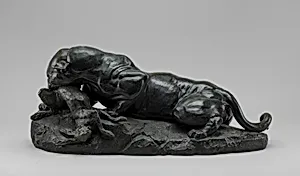
Jaguar Devouring a Hare
model 1850, cast by 1874
Medium
bronze
Dimensions
overall: 40.64 × 101.6 × 35.56 cm (16 × 40 × 14 in.)
Classification
Sculpture
Department
CSD
Museum
National Gallery of Art, Washington, D.C.
Credit
Corcoran Collection (Museum Purchase)
Accession Number
2015.19.3888
Rights
Public Domain
Art Historical Context
Antoine-Louis Barye’s *Jaguar Devouring a Hare*, modeled in 1850 and cast in bronze by 1874, captures a raw moment of nature’s ferocity. This dynamic sculpture depicts a powerful jaguar mid-feast on its prey, with the predator’s muscles tensed and claws gripping the hare in a visceral display of survival. Measuring 16 × 40 × 14 inches, its elongated form draws the viewer into the intensity of the hunt, showcasing Barye’s mastery of animal anatomy. A pioneer of the animalier style in 19th-century France, Barye elevated bronze sculpture by blending Romanticism’s dramatic energy with scientific precision, inspired by the Paris zoos and natural history collections of his era. His works challenged the neoclassical focus on human figures, bringing wild beasts to the forefront of fine art and influencing generations of sculptors. Cast in bronze—a medium prized for its durability and ability to hold intricate details and subtle patinas—this piece from the Corcoran Collection at the National Gallery of Art exemplifies Barye’s innovative lost-wax technique. It invites visitors to ponder the untamed beauty of the animal kingdom, a timeless reminder of nature’s primal drama.
About the Artist
Antoine-Louis Barye · 1795–1875
Antoine-Louis Barye (1795–1875) was born in Paris on September 24, the son of goldsmith Pierre Barye and Marguerite Barye. Following family tradition, he apprenticed as a goldsmith under his father and, around 1810, with Martin-Guillaume Biennais, goldsmith to Napoleon. After brief military service, Barye pursued sculpture, studying under François-Joseph Bosio in 1816 and painter Baron Antoine-Jea...