
Tom, Algerian Greyhound
model 1868, cast by 1874
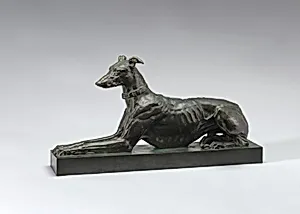
Medium
bronze
Dimensions
overall: 19.05 × 36.2 × 11.11 cm (7 1/2 × 14 1/4 × 4 3/8 in.)
Classification
Sculpture
Department
CSD
Museum
National Gallery of Art, Washington, D.C.
Credit
Corcoran Collection (Museum Purchase)
Accession Number
2015.19.3863
Rights
Public Domain
Art Historical Context
Antoine-Louis Barye a master of 19th-century French animal, crafted *Tom, Algerian Greyhound* as a model in 1868, with casts produced by 1874. This intimate bronze sculpture, measuring just 19 x 36 x 11 cm, captures the elegance of the slender Algerian sighthound in a poised, alert stance. Barye's keen eye for anatomy brings Tom's lithe muscles and graceful form to life, evoking the speed and nobility of the breed. Renowned as the founder of the animalier style—a Romantic movement celebrating wildlife with naturalistic precision—Barye drew inspiration from the Paris zoos and menageries of his era. His works bridged neoclassicism and realism, often depicting animals in dynamic motion to convey raw power and vitality. Bronze, his preferred medium, allowed for intricate detailing through lost-wax casting, ensuring durability and a rich patina that enhances the sculpture's lifelike sheen. Part of the Corcoran Collection at the National Gallery of Art, *Tom* reflects Barye's later career fascination with domestic yet exotic subjects. Visitors are drawn to its personal touch—the named hound suggesting a beloved companion—offering a window into Victorian-era admiration for elegant canines amid France's artistic golden age.
About the Artist
Antoine-Louis Barye · 1795–1875
Antoine-Louis Barye (1795–1875) was born in Paris on September 24, the son of goldsmith Pierre Barye and Marguerite Barye. Following family tradition, he apprenticed as a goldsmith under his father and, around 1810, with Martin-Guillaume Biennais, goldsmith to Napoleon. After brief military service, Barye pursued sculpture, studying under François-Joseph Bosio in 1816 and painter Baron Antoine-Jea...