
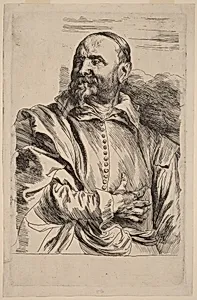
Jan Snellinx
probably 1626/1641
Medium
etching
Classification
Department
CG-E
Museum
National Gallery of Art, Washington, D.C.
Credit
Rosenwald Collection
Accession Number
1943.3.8256
Rights
Public Domain
Art Historical Context
Behold *Jan Snellinx*, a striking etching by the Flemish Baroque master Sir Anthony van Dyck, likely created between 1626 and 1641. This intimate portrait captures the sitter with van Dyck's signature elegance and psychological depth, showcasing his skill in translating the fluid brushwork of his paintings into the precise yet expressive medium of etching. As one of Europe's leading portraitists, van Dyck elevated printmaking during the early 17th century, producing a renowned series of etched portraits that democratized his artistry for a wider audience beyond oil canvases. Etching, where acid etches intricate lines into a copper plate, allowed van Dyck to achieve luminous effects and subtle tonal gradations reminiscent of his oil paintings. Housed in the National Gallery of Art's Rosenwald Collection, this print exemplifies the Baroque emphasis on realism and grandeur, reflecting Antwerp's vibrant artistic scene where van Dyck honed his craft before his influential years at the English court. Jan Snellinx, depicted with poised intensity, represents the cultured elite of the era, immortalized in a technique that bridged painting and print culture. Visitors will appreciate how van Dyck's innovative approach made high art accessible, influencing generations of engravers and underscoring the etching's role in preserving likenesses amid the Dutch Golden Age's print boom.
About the Artist
Sir Anthony van Dyck · 1599–present
Sir Anthony van Dyck (1599–1641) was a Flemish painter who became one of the most important portraitists in the history of European art. Born in Antwerp, he showed extraordinary precocious talent and entered the workshop of Peter Paul Rubens as a teenager, quickly becoming Rubens's most gifted assistant and an independent master in his own right by the age of eighteen. Van Dyck spent formative ye...