
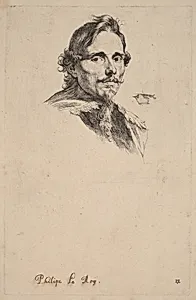
Philippe le Roy, Lord of Ravels
probably 1626/1641
Medium
etching
Dimensions
plate: 24.3 x 15.7 cm (9 9/16 x 6 3/16 in.) sheet: 26.4 x 17.7 cm (10 3/8 x 6 15/16 in.)
Classification
Department
CG-E
Museum
National Gallery of Art, Washington, D.C.
Credit
Rosenwald Collection
Accession Number
1943.3.9120
Rights
Public Domain
Art Historical Context
Behold the elegant etching *Philippe le Roy, Lord Ravels* by Sir Anthony van Dy, a Flemish Baroque master renowned for his luminous portraits of nobility. Created probably between 1626 and1641, this intimate print captures the lord's poised demeanor, likely from van Dyck's celebrated *Iconography* series groundbreaking collection of over 100 etched portraits documenting Europe's intellectual and aristocratic elite during the artist's Antwerp and early London periods. Etching, van Dyck's chosen medium here (plate: 24.3 × 15.7 cm), allowed him to translate his painterly genius into precise, fluid lines on copper plates, inked and pressed onto paper (sheet: 26.4 × 17.7 cm). This technique democratized his aristocratic imagery, making high-society portraits accessible beyond canvas while showcasing his signature sensitivity to texture, gaze, and status—hallmarks of Baroque portraiture that influenced generations. Housed in the National Gallery of Art's Rosenwald Collection (Department CG-E), this work highlights van Dyck's role as a cultural chronicler, bridging Flemish tradition and English court elegance. Imagine Philippe le Roy, a Flemish noble, gazing out as a timeless emblem of 17th-century refinement.
About the Artist
Sir Anthony van Dyck · 1599–present
Sir Anthony van Dyck (1599–1641) was a Flemish painter who became one of the most important portraitists in the history of European art. Born in Antwerp, he showed extraordinary precocious talent and entered the workshop of Peter Paul Rubens as a teenager, quickly becoming Rubens's most gifted assistant and an independent master in his own right by the age of eighteen. Van Dyck spent formative ye...