
Jewelry Designs
Medium
Classification
Department
Smithsonian Collection
Museum
Smithsonian American Art Museum
Credit
Purchased for the Museum by the Advisory Council
Accession Number
1921-6-466-6
Rights
Public Domain
About this artwork
Research in Progress
Art Historical Context
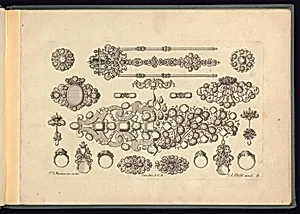
**Jewelry Designs** by Friedrich Jacob Morison, a German artist active from 1693 to 1699, dates to around 1700 and exemplifies the intricate printmaking traditions of late Baroque Europe. Created as a print—likely an engraving—this work served as a pattern sheet for jewelers, showcasing elaborate motifs that would inspire luxurious adornments. Morison's designs capture the opulent aesthetic of the era, with scrolling forms, floral elements, and gemstone settings that reflect the period's fascination with grandeur and technical virtuosity. In the early 18th century, such prints were vital tools for disseminating fashion and craftsmanship across workshops in Germany and beyond. They bridged artistry and commerce, allowing goldsmiths to replicate high-style jewelry without direct patronage. Morison's output, produced at the cusp of the Baroque-to-Rococo transition, hints at evolving tastes toward lighter, more playful ornamentation amid Europe's courts. Acquired for the Smithsonian American Art Museum through the Advisory Council, this piece underscores the global exchange of design ideas that influenced early American artisans. Though research continues, it offers a window into the refined world of 1700s luxury, inviting visitors to imagine these patterns transformed into shimmering brooches and rings. (198 words)