
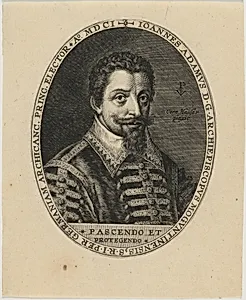
Joannes Adams
Medium
engraving
Dimensions
plate: 14 × 11 cm (5 1/2 × 4 5/16 in.)
Classification
Department
CG-E
Museum
National Gallery of Art, Washington, D.C.
Credit
Rosenwald Collection
Accession Number
1950.14.4
Rights
Public Domain
Art Historical Context
Step into the intricate world of 17th-century printmaking with *Joannes Adams*, a engraving by Crispijn de Passe I created in 1601 This small-scale work, measuring just 14 ×11 cm, captures the refined artistry of de Passe, a leading Dutch engraver from Antwerp known for his meticulous line work and contributions to theist style. Active during the transition from the Renaissance to the Dutch Golden Age, de Passe portraits and reproductive prints that circulated widely among Europe's elite, making high art accessible through multiples. Engraving, the medium here, involves incising fine lines into a metal plate with a burin, then inking and printing to yield sharp, durable images ideal for detailed portraits like this one. De Passe's technique shines in its precision, likely rendering Joannes Adams—a figure possibly from scholarly or ecclesiastical circles—with expressive features and period attire, evoking the humanist spirit of the era. Such prints were prized collectibles, bridging art and scholarship. Housed in the National Gallery of Art's Rosenwald Collection, this piece exemplifies the technical mastery and cultural exchange of Northern European print culture around 1600. Visitors will appreciate its intimate scale, perfect for contemplation, revealing how engravings preserved likenesses and legacies for generations.
About the Artist
Crispijn de Passe I
Crispijn de Passe I, born around 1564 in Arnemuiden, Zeeland, emerged as one of the most influential Dutch engravers and print publishers of his era. He relocated to Antwerp as a youth, where he honed his craft amid the city's vibrant printmaking scene, becoming an independent master in the Guild of Saint Luke by 1584–1585. There, he worked as a reproductive engraver, primarily after designs by pr...