
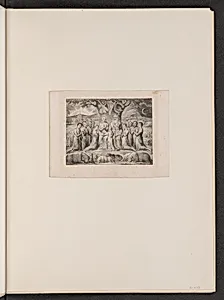
Job and His Family
1825
Medium
engraving on thick paper
Classification
Portfolio
Department
CG-E
Museum
National Gallery of Art, Washington, D.C.
Credit
Rosenwald Collection
Accession Number
1943.3.1654
Rights
Public Domain
Art Historical Context
William Blake's *Job and His Family*1825) invites visitors into the visionary world of one of Romanticism's most enigmatic artists. Created late in Blake's life, this engraving captures a moment of domestic serenity from the biblical Book of Job, portraying the prosperous patriarch surrounded by his loved ones amid symbols of wealth and piety. Blake, a poet, painter, and printmaker who claimed divine inspiration, infused his works with mystical intensity, blending spiritual narrative with profound human emotion. Executed as an engraving on thick laid paper, the piece exemplifies Blake's technical mastery. His intricate line work builds dramatic contrasts and subtle textures, evoking a sense of otherworldly light and shadow. As part of a larger portfolio of Job illustrations—Blake's final major print project—this work reflects his lifelong fascination with faith, suffering, and redemption, bridging Enlightenment rationalism and Romantic individualism. Housed in the National Gallery of Art's Rosenwald Collection (Department CG-E), *Job and His Family* stands as a testament to Blake's enduring influence on printmaking and illustration. Printed just before his death, it offers a poignant glimpse into the artist's unyielding creative spirit, perfect for contemplation in our virtual galleries.
About the Artist
William Blake · 1757–1827
William Blake (1757–1827) stands as one of the most visionary and unconventional artists in British history, a poet-painter-printmaker whose mystical imagination and radical vision profoundly shaped the Romantic movement. Born in London's Soho district, Blake experienced visions from childhood—claiming to see angels in trees at age eight—and these spiritual encounters would guide his art throughou...