
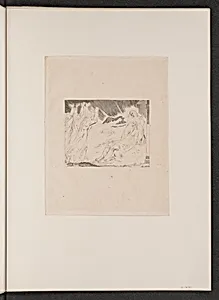
Job's Comforters
1825
Medium
engraving on thick paper
Classification
Portfolio
Department
CG-E
Museum
National Gallery of Art, Washington, D.C.
Credit
Rosenwald Collection
Accession Number
1943.3.1678
Rights
Public Domain
Art Historical Context
William Blake's *Job's Comforters (1825) is a poignant engraving from his monumental series *Illustrations of the Book Job*, one of the artist's final and most ambitious projects. Depicting the biblical moment when Job's friends—Eliphaz, Bildad, and Zophar—arrive to console him amid his suffering, the image captures a tense gathering under a starry sky, with Job seated in despair. Blake, a visionary Romantic artist and poet (1757–1827), drew from his earlier watercolors to create these 22 engravings, blending spiritual depth with dramatic composition. Printed on thick paper using Blake's innovative relief etching technique, the work exemplifies his mastery of integrating text, line, and tone. This method allowed him to produce luminous, handmade prints that rival paintings in expressiveness, emphasizing themes of faith, torment, and divine mystery central to the Book of Job. As part of the Rosenwald Collection in the National Gallery of Art's CG-E Department (Portfolio classification), it showcases Blake's defiance of industrial printing, prioritizing artisanal craft during the early Industrial Revolution. This engraving invites visitors to ponder Job's unyielding piety against hollow counsel, reflecting Blake's lifelong quest to illuminate the human soul's trials. A testament to his mystical genius, it remains a highlight of Romantic printmaking.
About the Artist
William Blake · 1757–1827
William Blake (1757–1827) stands as one of the most visionary and unconventional artists in British history, a poet-painter-printmaker whose mystical imagination and radical vision profoundly shaped the Romantic movement. Born in London's Soho district, Blake experienced visions from childhood—claiming to see angels in trees at age eight—and these spiritual encounters would guide his art throughou...