
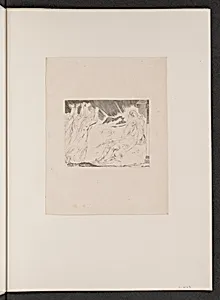
Job's Comforters
1825
Medium
engraving on thick paper
Classification
Portfolio
Department
CG-E
Museum
National Gallery of Art, Washington, D.C.
Credit
Rosenwald Collection
Accession Number
1943.3.1679
Rights
Public Domain
Art Historical Context
William Blake's *Job's Comforters (1825), an on thick paper, draws from the biblical Book of Job, portraying the moment when Job's three friends—Eliphaz, Bildad, and Zophar—ive to console him during his profound suffering. Yet their presence underscores irony: their words prove more accusatory than healing, a theme Blake explores with visionary intensity. As a cornerstone of Romantic art, this work reflects Blake's lifelong fascination with scripture, human anguish, and spiritual redemption, rendered in his distinctive linear style that fuses mysticism with raw emotion. The engraving belongs to Blake's final masterpiece, the *Illustrations of the Book of Job*, a series of 22 plates he painstakingly engraved himself at age 68. His technique—precise, swirling lines etched into copper plates and printed on sturdy paper—allows for luminous contrasts and symbolic depth, evoking both earthly torment and otherworldly light. This medium was ideal for Blake, a pioneering printmaker who bypassed traditional publishing to control every facet of his art. Now in the National Gallery of Art's Rosenwald Collection (Department CG-E, Portfolio classification), *Job's Comforters* captivates with its psychological nuance and enduring questions about faith and friendship. Visitors, pause here to ponder Blake's bold reminder: true comfort often lies beyond words.
About the Artist
William Blake · 1757–1827
William Blake (1757–1827) stands as one of the most visionary and unconventional artists in British history, a poet-painter-printmaker whose mystical imagination and radical vision profoundly shaped the Romantic movement. Born in London's Soho district, Blake experienced visions from childhood—claiming to see angels in trees at age eight—and these spiritual encounters would guide his art throughou...