
Job's Comforters
1825
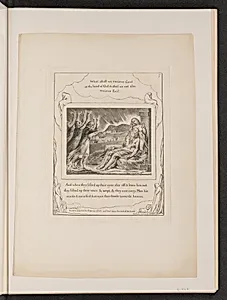
Medium
engraving on thick paper
Classification
Portfolio
Department
CG-E
Museum
National Gallery of Art, Washington, D.C.
Credit
Rosenwald Collection
Accession Number
1943.3.1681
Rights
Public Domain
Art Historical Context
William Blake's *Job's Comforters (1825), an on thick paper, captures a pivotal moment from the Book of Job in the Bible. In this scene, Job's three friends—Eliphaz, Bildad, and Zophar—visit the suffering patriarch amid his trials of faith, offering solace that soon turns to accusation. Blake, a visionary artist and poet of the Romantic era, produced this as part of his monumental series of 22 engravings illustrating Job's story, published in 1826 near the end of his life. These works reflect Blake's deep engagement with biblical themes, blending mysticism, humanism, and critique of institutional religion. Printed from copper plates using Blake's innovative relief etching technique, the image exemplifies his mastery of line and tonal contrast on thick laid paper, allowing for rich, expressive details. The figures' dramatic poses and ethereal auras convey profound emotional tension, aligning with Blake's symbolic style that influenced later Symbolists and Pre-Raphaelites. Housed in the National Gallery of Art's Rosenwald Collection (Department CG-E, Portfolio classification), it showcases Blake's fusion of text and image as a divine vision reborn through printmaking. This engraving invites visitors to ponder enduring questions of suffering and divine justice, a testament to Blake's genius in transforming scripture into timeless art.
About the Artist
William Blake · 1757–1827
William Blake (1757–1827) stands as one of the most visionary and unconventional artists in British history, a poet-painter-printmaker whose mystical imagination and radical vision profoundly shaped the Romantic movement. Born in London's Soho district, Blake experienced visions from childhood—claiming to see angels in trees at age eight—and these spiritual encounters would guide his art throughou...