
Job's Comforters
1825
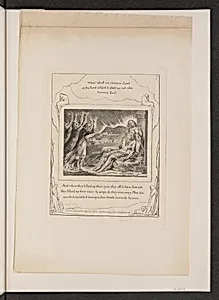
Medium
engraving on thick paper
Classification
Portfolio
Department
CG-E
Museum
National Gallery of Art, Washington, D.C.
Credit
Rosenwald Collection
Accession Number
1943.3.1680
Rights
Public Domain
Art Historical Context
William Blake's *Job's Comforters (1825), an engraving on thick laid paper, captures a pivotal moment from the biblical Book of Job. Part of Blake's monumental series *Illustrations of the Book of Job*—his final and most ambitious print project—this image depicts Job's three friends, Eliphaz, Bildad, and Zophar, arriving to console him amid his profound suffering. Yet, as the title suggests, their "comfort" rings hollow, embodying misguided judgment rather than true empathy, a theme central to the Old Testament narrative. Printed from copper plates that Blake meticulously engraved himself after decades of refinement, the work exemplifies his visionary Romantic style. Intricate lines and dramatic contrasts evoke a spiritual intensity, blending mysticism with humanism. Blake, a poet, painter, and radical thinker, infused the series with his prophetic worldview, critiquing organized religion while exploring faith's trials. Housed in the National Gallery of Art's Rosenwald Collection (Department CG-E, Portfolio classification), this engraving highlights Blake's mastery of relief etching and his belief in art as divine revelation. A testament to 19th-century British printmaking innovation, it invites visitors to ponder suffering, friendship, and the soul's resilience.
About the Artist
William Blake · 1757–1827
William Blake (1757–1827) stands as one of the most visionary and unconventional artists in British history, a poet-painter-printmaker whose mystical imagination and radical vision profoundly shaped the Romantic movement. Born in London's Soho district, Blake experienced visions from childhood—claiming to see angels in trees at age eight—and these spiritual encounters would guide his art throughou...