
Job's Evil Dreams
1825
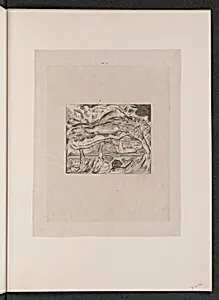
Medium
engraving on thin paper
Dimensions
plate: 21.7 × 17 cm (8 9/16 × 6 11/16 in.) sheet: 25.9 × 20.3 cm (10 3/16 × 8 in.)
Classification
Portfolio
Department
CG-E
Museum
National Gallery of Art, Washington, D.C.
Credit
Rosenwald Collection
Accession Number
1943.3.1693
Rights
Public Domain
Art Historical Context
William Blake's *Job's Evil Dreams*1825) is a haunting engraving from his monumental series *Illustrations of the Book Job*, a profound exploration of the biblical tale of suffering, faith, and divine mystery. Created in the final year of Blake's life, this plate captures Job tormented by nightmarish visions—fiery figures and swirling demonssymbolizing the trials that test his piety. As a cornerstone of Romanticism, Blake's visionary style blends mysticism, symbolism, and raw emotion, drawing from his lifelong fascination with scripture, poetry, and the supernatural. Rendered in Blake's innovative relief etching technique on thin paper, the work measures a compact plate of 21.7 × 17 cm, allowing for intricate line work that evokes both delicacy and intensity. This method, which Blake perfected, fused text and image on copper plates, enabling him to print, hand-color, and proof impressions himself—revolutionary for its time and emblematic of his defiance of conventional printmaking hierarchies. Housed in the National Gallery of Art's Rosenwald Collection (Department CG-E, Portfolio classification), this piece invites visitors to ponder enduring themes of human endurance amid chaos. Blake's engravings remain cultural touchstones, bridging art, literature, and spirituality for generations.
About the Artist
William Blake · 1757–1827
William Blake (1757–1827) stands as one of the most visionary and unconventional artists in British history, a poet-painter-printmaker whose mystical imagination and radical vision profoundly shaped the Romantic movement. Born in London's Soho district, Blake experienced visions from childhood—claiming to see angels in trees at age eight—and these spiritual encounters would guide his art throughou...