
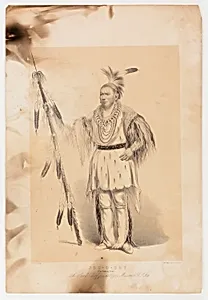
Joc-o-sot, the Walking Bear
Medium
Graphic Arts-Print
Classification
Graphic Arts-Print
Department
Smithsonian Collection
Museum
Smithsonian American Art Museum
Credit
Smithsonian American Art Museum, Transfer from the National Museum of Natural History, Department of Ethnology, Smithsonian Institution
Accession Number
1985.66.386,592H
Rights
Public Domain
Tags
Art Historical Context
Step into the world of 19th-century America with *Joc-o-sot, the Walking Bear*, a captivating graphic arts print by George Catlin, now housed in the Smithsonian American Museum. This full-length portrait depicts Joc-o-sot, a Native American figure—likely from the Iowa or Sauk tribes—captured in a dignified pose that highlights his stature and cultural regalia. Catlin, a pioneering artist known for his vivid documentation of Indigenous peoples, created this as part of his expansive portfolio, emphasizing the humanity and nobility of his subjects. Catlin traveled extensively through the Great Plains in the 1830s, painting over 600 portraits to preserve Native American life before rapid westward expansion altered it forever. Works like this print, transferred from the National Museum of Natural History's ethnology collection, reflect his mission to create an authentic visual record, often exhibited in his famous "Indian Gallery." The print medium allowed wider dissemination of these images, bridging art and ethnography. Though the exact date is unknown, *Joc-o-sot, the Walking Bear* stands as a testament to Catlin's Hudson River School influences and his commitment to cultural advocacy. It invites visitors to reflect on the resilience of Native traditions amid historical change, offering a poignant glimpse into a vanishing era.
About the Artist
George Catlin · 1796–1872
George Catlin (1796–1872), born in Wilkes-Barre, Pennsylvania, to Putnam Catlin and Polly Sutton—who had been captured by Native Americans during the 1778 Battle of Wyoming—initially pursued a legal career. Trained at Litchfield Law School, he was admitted to the bar in 1819 but abandoned law after two years to study art in Philadelphia in 1823. Self-taught as a portraitist, Catlin quickly gained ...