
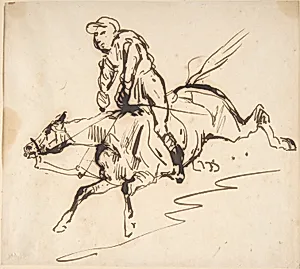
Jockey on a Horse
Medium
Pen and brown ink
Dimensions
6 3/4 x 7 11/16 in. (17.2 x 19.5 cm)
Classification
Drawings
Department
Drawings and Prints
Museum
Metropolitan Museum of Art, New York, NY
Credit
Bequest of Harry G. Sperling, 1971
Accession Number
1975.131.110
Rights
Public Domain
Tags
Art Historical Context
Behold the dynamic sketch *Jockey on a Horse a captivating 19th-century drawing attributed to Théodore Géricault or an anonymous French artist. Rendered in pen and brown ink on a sheet measuring just 6 3/4 x 7 11/16 inches, this work captures a jockey astride a rearing horse in a moment of intense motion. Housed in the Metropolitan Museum of Art's Department of Drawings and Prints, it entered the collection through the bequest of Harry G. Sperling in 1971. Géricault, a leading figure of French Romanticism, was renowned for his fascination with horses and the human form in action—seen in masterpieces like *The Raft of the Medusa* (1819). This drawing likely served as a preparatory study, showcasing his mastery of fluid, expressive lines in pen and ink. The brown ink's warm tone and rapid strokes convey the horse's muscular tension and the jockey's poised control, evoking the thrill of equestrian races popular in 19th-century France. Such intimate sketches highlight the artist's meticulous observation of anatomy and movement, bridging studio preparation with the raw energy of life. For visitors, it offers a glimpse into Romanticism's emphasis on emotion and drama, reminding us how small-scale works fueled grand artistic visions.
About the Artist
Théodore Gericault|Anonymous, French, 19th century · 1791–1824
Théodore Géricault, born Jean-Louis André Théodore Géricault on September 26, 1791, in Rouen, France, into a prosperous family—his father a lawyer turned tobacco merchant and his mother from a line of growers—moved to Paris around 1797. Displaying early artistic promise, recognized by painter Jean-Louis Laneuville, he began formal training in 1808 under Carle Vernet, mastering English sporting art...