
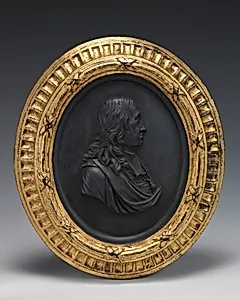
John Milton
late 18th century
Medium
Black basalt ware
Dimensions
6 3/8 × 5 1/2 in. (16.2 × 14 cm)
Classification
Ceramics-Pottery
Culture
British, Etruria, Staffordshire
Department
European Sculpture and Decorative Arts
Museum
Metropolitan Museum of Art, New York, NY
Credit
Purchase, Joseph Pulitzer Bequest, 1942
Accession Number
42.76.40
Rights
Public Domain
Tags
Art Historical Context
This elegant profile portrait medallion of the renowned English poet John Milton (1608–1674) was crafted by Josiah Wedgwood, the innovative founder of the Wedgwood pottery firm, in the late 18th century. Measuring just 6 3/8 × 5 1/2 inches, it captures Milton's dignified visage in stark profile, evoking the heroic busts of ancient Rome. Produced at Wedgwood's Etruria factory in Staffordshire, England, this piece reflects the neoclassical revival of the era, when Enlightenment thinkers celebrated literary giants alongside classical antiquity. Wedgwood's signature black basalt ware—an unglazed, fine-grained stoneware fired to a rich, matte black resembling volcanic basalt—revolutionized ceramics. Developed in the 1760s, this durable medium allowed for intricate relief portraits that mimicked expensive bronze or marble sculptures, making them accessible to a wider audience. Wedgwood produced series of such medallions honoring poets, philosophers, and reformers, blending industrial precision with artistic refinement. Housed today in the Metropolitan Museum of Art's European Sculpture and Decorative Arts department, this work underscores Wedgwood's role in elevating British pottery to fine art status. It not only immortalizes Milton, author of *Paradise Lost*, but also embodies 18th-century cultural reverence for intellectual heroes, bridging literature and neoclassical design.
About the Artist
Josiah Wedgwood · 1730–1795
Josiah Wedgwood (1730–1795) was born in Burslem, Staffordshire, the thirteenth child of a potter whose family had worked in the craft since the seventeenth century. Apprenticed to his elder brother Thomas following their father's death, he went on to a partnership with Thomas Whieldon of Fenton — the most respected potter in England at the time — which gave him command of all the principal techniq...