
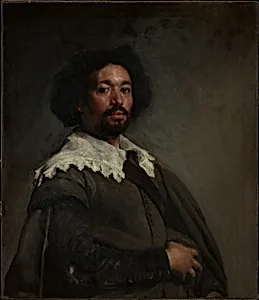
Juan de Pareja (ca. 1608–1670)
Medium
Oil on canvas
Dimensions
32 x 27 1/2 in. (81.3 x 69.9 cm)
Classification
Paintings
Department
European Paintings
Museum
Metropolitan Museum of Art, New York, NY
Credit
Purchase, Fletcher and Rogers Funds, and Bequest of Miss Adelaide Milton de Groot (1876-1967), by exchange, supplemented by gifts from friends of the Museum, 1971
Accession Number
1971.86
Rights
Public Domain
Tags
Art Historical Context
Diego Velázquez's *Juan de Pareja* (1650) is a stunning oil-on-canvas portrait that exemplifies the Spanish master's unparalleled skill in capturing human presence. Measuring 32 x 27½ inches, this Baroque gem depicts Juan de Pareja, Vel's trusted assistant and a man of African descent, with a direct gaze and subtle modeling that conveys quiet dignity. Housed in the Metropolitan Museum Art's European Paintings department, it reflects Velázquez's tenure as court painter to Philip IV during Spain's Golden Age. Painted on the eve of Velázquez's second Italian journey, the work showcases his revolutionary loose brushwork and masterful use of light, which create a lifelike texture in the skin, fabrics, and background. Exhibited in Rome, it drew widespread acclaim for its realism, underscoring Velázquez's influence on European portraiture. Pareja, who lived circa 1608–1670 and was himself a painter, highlights the era's social complexities, as he was enslaved by Velázquez before gaining freedom around this time. This intimate portrait endures as a cultural touchstone, bridging artistry and history, inviting viewers to ponder identity and mastery in 17th-century Europe.
About the Artist
Velázquez (Diego Rodríguez de Silva y Velázquez) · 1599–1660
Diego Rodríguez de Silva y Velázquez, baptized on June 6, 1599, in Seville, Spain, emerged as one of the supreme masters of the Spanish Baroque. The eldest son of notary Juan Rodríguez de Silva and Jerónima Velázquez, he displayed prodigious talent early on. At around age 11 or 12, he apprenticed under Francisco Pacheco, the esteemed Sevillian painter, theorist, and writer whose studio functioned ...