
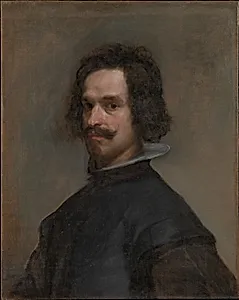
Portrait of a Man, Possibly a Self-Portrait
Medium
Oil on canvas
Dimensions
27 x 21 3/4 in. (68.6 x 55.2 cm)
Classification
Paintings
Department
European Paintings
Museum
Metropolitan Museum of Art, New York, NY
Credit
The Jules Bache Collection, 1949
Accession Number
49.7.42
Rights
Public Domain
Tags
Art Historical Context
Step into the masterful world of Diego Rodríguez de y Velázquez with *Portrait of a Man, a Self-Portrait*ca. 1635), an oil on canvas gem from the Spanish Golden Age. Measuring 27 x 21 3/4 inches, this intimate work captures a dignified figure—perhaps the artist himself—in a moment of quiet intensity. Housed in The Met's European Paintings department as part of The Jules Bache Collection (1949), it exemplifies Velázquez's tenure as court painter to King Philip IV, where he elevated portraiture to unprecedented realism. Velázquez, a Baroque innovator, masterfully employs loose brushwork and subtle tenebrism—dramatic contrasts of light and shadow—to convey psychological depth. The man's piercing gaze and textured attire, rendered with remarkable fluidity, reflect his innovative technique that blurred the lines between observation and artistry, influencing later masters like Manet and Picasso. This period marked Velázquez's maturity, blending Flemish precision with Spanish grandeur. Though its exact identity remains tantalizingly uncertain, the portrait's cultural resonance lies in its humanity: a window into 17th-century Spanish nobility and the artist's own enigmatic persona. A must-see for lovers of introspective genius! (198 words)
About the Artist
Velázquez (Diego Rodríguez de Silva y Velázquez) · 1599–1660
Diego Rodríguez de Silva y Velázquez, baptized on June 6, 1599, in Seville, Spain, emerged as one of the supreme masters of the Spanish Baroque. The eldest son of notary Juan Rodríguez de Silva and Jerónima Velázquez, he displayed prodigious talent early on. At around age 11 or 12, he apprenticed under Francisco Pacheco, the esteemed Sevillian painter, theorist, and writer whose studio functioned ...