
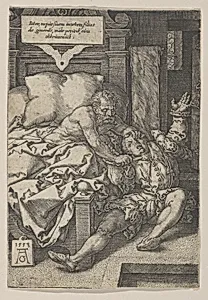
Judge Herkinbald (Archambauld) Stabbing his Nephew
Medium
Engraving
Dimensions
Sheet: 4 7/16 × 2 11/16 in. (11.3 × 6.9 cm)
Classification
Prints
Department
Drawings and Prints
Museum
Metropolitan Museum of Art, New York, NY
Credit
Gift of Harry G. Friedman, 1962
Accession Number
62.635.511b
Rights
Public Domain
Tags
About this artwork
Heinrich Aldegrever's "Judge Herkinbald (Archambauld) Stabbing his Nephew" (1553) The work, executed in engraving, measures sheet: 4 7/16 × 2 11/16 in. and Prints served crucial roles in disseminating artistic ideas and images across geographic and social boundaries. This work provides valuable insights into Heinrich Aldegrever's artistic practice and the broader cultural and material contexts of its creation.
Art Historical Context
In Heinrich Aldegrever's *Judge HerkinbaldArchambauld) St his Nephew* (3), a dramatic moment unfolds in a intimate bedroom setting. The German Renaissance artist, one of the "Little Masters" renowned for his intricate small-scale prints, depicts the legendary Flemish judge Herkinbaldalso known as Archambauld—delivering fatal justice to his corrupt nephew. This scene captures raw suffering among men, symbolizing unwavering moral integrity over familial ties, drawn from medieval tales of righteous vengeance. Crafted as an engraving on a modest sheet measuring just 4 7/16 × 2 11/16 inches (11.3 × 6.9 cm), the work showcases Aldegrever's mastery of fine lines and meticulous detail, hallmarks of Northern Renaissance printmaking. Engravings like this were revolutionary, enabling widespread dissemination of complex narratives and artistic ideas across Europe, from noble courts to humble homes, bridging geographic and social divides. Housed in the Metropolitan Museum of Art's Drawings and Prints department (gift of Harry G. Friedman, 1962), this print offers a window into 16th-century cultural values—justice, piety, and human drama—while highlighting the era's innovative use of prints as accessible storytelling tools. A poignant reminder of art's power to moralize and captivate.
About the Artist
Heinrich Aldegrever · 1502–1561
Heinrich Aldegrever, born in 1502 in Paderborn, Westphalia, to parents Herman and Katherine Trippenmeker—a family of clog-makers known by the dialect name Trippenmecker—emerged as a multifaceted artist in the German Renaissance. His early training remains undocumented, though he likely apprenticed in a Soest goldsmith's workshop after relocating there around 1525, where he joined the painters' gui...