
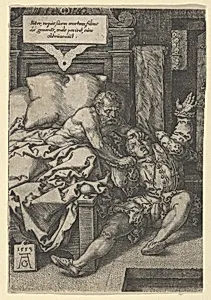
Judge Herkinbald (Archambauld) Stabbing His Nephew
Medium
Engraving
Dimensions
Sheet: 4 7/16 × 3 1/16 in. (11.2 × 7.7 cm)
Classification
Prints
Department
Drawings and Prints
Museum
Metropolitan Museum of Art, New York, NY
Credit
Gift of Harry G. Friedman, 1959
Accession Number
59.644.10
Rights
Public Domain
Tags
Art Historical Context
In the intimate confines of a bedroom, Heinrich Aldegrever's 1553 engraving *Judge Herkinbald (ambauld) Stabbing Nephew* captures a of raw moral drama. This small-scale print (4 7/16 × 3 1/16 in.) depicts the legendary judge Herkinbald, a figure from medieval lore symbolizing unyielding justice, as he strikes down his corrupt nephew with a dagger. The scene evokes suffering and familial betrayal, rendered with intense emotional immediacy amid domestic surroundings, highlighting the personal cost of righteousness. Aldegrever, a prominent German engraver of the Northern Renaissance and one of the "Little Masters" known for their meticulous small-format works, excels in this medium's precision. Engraving allowed for fine lines and intricate details, making affordable prints ideal for disseminating moral tales during the Reformation era. Produced in 1553, amid religious and social upheavals, the artwork underscores themes of impartial law over blood ties, drawing from a popular legend where Herkinbald miraculously receives divine sanction for his act. Housed in the Metropolitan Museum of Art's Drawings and Prints department (gift of Harry G. Friedman, 1959), this piece invites reflection on justice's harsh demands. Its cultural resonance lies in how such prints educated and moralized for everyday audiences, blending artistry with ethical storytelling.
About the Artist
Heinrich Aldegrever · 1502–1561
Heinrich Aldegrever, born in 1502 in Paderborn, Westphalia, to parents Herman and Katherine Trippenmeker—a family of clog-makers known by the dialect name Trippenmecker—emerged as a multifaceted artist in the German Renaissance. His early training remains undocumented, though he likely apprenticed in a Soest goldsmith's workshop after relocating there around 1525, where he joined the painters' gui...