
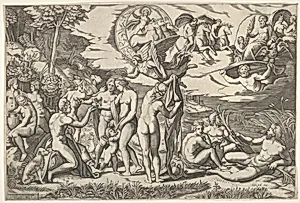
Judgment of Paris: Paris extends his hand toward Venus, who stands between Juno and Minerva, surrounded by reclining and seated figures; above are a winged figure carrying a laurel wreath, a charioteer driving four horses, Castor and Pollux, and Jupiter accompanied by Ganymede, an eagle, Diana, and two other female figures
Medium
Engraving
Dimensions
Sheet: 11 1/2 x 17 3/16 in. (29.2 x 43.7 cm)
Classification
Prints
Department
Drawings and Prints
Museum
Metropolitan Museum of Art, New York, NY
Credit
Bequest of Phyllis Massar, 2011
Accession Number
2012.136.861
Rights
Public Domain
Tags
Art Historical Context
This enchanting engraving, titled *Judgment of Paris*, captures a pivotal moment from classical mythology: the Trojan prince Paris awarding the golden apple to Venus (Aphrodite) as thest goddess, flanked by the spurned Juno (Hera) and Minerva (ena). Surrounding them are reclining and seated figures, while above soar a winged figure bearing a laurel wreath, charioteer guiding four horses, the twins Castor and Poll, and Jupiter (Zeus) with Ganymede, an, Diana, and other deities. Created around 1520–50, it measures 11½ x 17⅛ inches and exemplifies the Renaissance revival of ancient myths. Designed by the High Renaissance master Raphael (Raffaello Sanzio), whose graceful compositions and idealized forms defined the era, the print was masterfully engraved by Marcantonio Raimondi, Raphael's foremost collaborator in translating paintings into print. Publisher Antonio Salamanca helped disseminate it widely. Engraving's precision allowed intricate details—like the dynamic horses and ethereal figures—to reach collectors across Europe, making elite art accessible and fueling the print boom of the 16th century. Housed in the Metropolitan Museum of Art's Drawings and Prints department (Bequest of Phyllis Massar, 2011), this work highlights engraving's role in preserving Raphael's legacy after his 1520 death. The myth's choice sparked the Trojan War, symbolizing beauty's triumph over power and wisdom—a timeless theme rendered with Raphael's harmonious elegance.
About the Artist
Marcantonio Raimondi|Raphael (Raffaello Sanzio or Santi)|Antonio Salamanca · 1475–1534
Marcantonio Raimondi (c. 1480–1534), born near Bologna, Italy, emerged as one of the Renaissance's premier engravers, revolutionizing printmaking through his mastery of reproductive techniques. He trained in the workshop of the goldsmith, painter, and niellist Francesco Francia, whose influence is evident in his early engravings, such as the goldsmith-like shading in *Pyramus and Thisbe* (1505), h...