
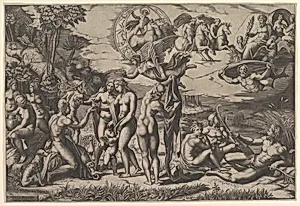
The Judgment of Paris
Medium
Engraving
Dimensions
Sheet (Trimmed): 11 1/4 × 16 3/4 in. (28.6 × 42.5 cm)
Classification
Prints
Department
Drawings and Prints
Museum
Metropolitan Museum of Art, New York, NY
Credit
Gift of Henry Walters, 1917
Accession Number
17.37.157
Rights
Public Domain
Tags
Art Historical Context
Behold *The Judgment of Paris*, masterful engraving from the High Renaissance era (1515–27), now housed in the Metropolitan Museum of Art's Drawings and Prints department. This iconic scene draws from classical mythology, where the Trojan prince Paris must choose the fairest goddess among Hera, Athena, and Aphroditeoffering an apple that sparks the Trojan War. Designed by the unparalleled Raphael (Raffaello Sanzio), it was meticulously engraved by Marcantonio Raimondi and Marco Dente, capturing Raphael's graceful idealism and anatomical precision in dynamic figures, including striking male and female nudes astride horses. Engraving, a revolutionary printmaking technique involving incised metal plates, allowed Raphael's compositions to reach a broad audience far beyond Rome. Raimondi's virtuosic burin work reproduces Raphael's fluid lines and harmonious proportions with astonishing fidelity, embodying the High Renaissance pursuit of beauty and classical antiquity. At 11¼ × 16¾ inches, this trimmed sheet exemplifies how prints democratized elite art, influencing collectors and artists across Europe. A gift from Henry Walters in 1917, this work highlights the era's fusion of myth, nudity, and equine energy, inviting visitors to ponder timeless themes of judgment and desire through Raphael's enduring genius.
About the Artist
Marco Dente|Marcantonio Raimondi|Raphael (Raffaello Sanzio or Santi) · 1515–1527
Marco Dente (died 1527), also known as Marco da Ravenna, was among the most accomplished printmakers working in Rome during the High Renaissance, a period that witnessed an extraordinary flowering of engraving as both a reproductive and an independent artistic medium. Little is known of his early training, but by the second decade of the sixteenth century he had established himself in the orbit of...