
Jug with medallions
ca. 1650 - ca. 1724
Medium
turning
Dimensions
7; 14.1; 21; 11.7; 8.6; 23.4
Rights
Public Domain
About this artwork
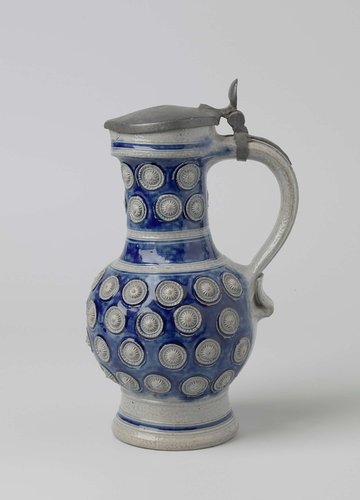
Kan van steengoed op hoge voet met een bolvormig lichaam en lange nek met uitlopende rand en geknepen tuit. Het C-vormige oor is bevestigd aan de rand en de schouder. Enkele profielen op de rand en voet. Gedeeltelijk bedekt met kobaltblauw. Op de buik en nek kleine gedrukte en opgelegde medaillons met een rozet. De schouder met een band in blauw. Bevestigd aan het oor een tinnen montuur met deksel; een geslagen bloem aan de binnenzijde. Westerwald.
Art Historical Context
This elegant stoneware jug, originating from the Westerwald region in Germany around 1650–1724, exemplifies the masterful pottery traditions of the Rhineland during the Baroque era. Standing at 23.4 cm tall, it features a high foot, bulbous body, elongated neck with a flaring rim and pinched spout, and a sturdy C-shaped handle linking the rim to the shoulder. Crafted by a skilled potter using wheel-throwing techniques—known as "turning"— robust form was ideal for everyday use, from serving beverages to display. The jug's decoration highlights innovative 17th- and 18th-century ceramic artistry: a partial cobalt blue glaze lends a rich, vibrant hue, while small printed and applied medallions adorned with rosettes grace the belly and neck. A blue band encircles the shoulder, and subtle profiles edge the rim and foot. A pewter mount with a lidded top, featuring a hammered flower inside, adds a luxurious metalworking touch, blending pottery and silversmithing crafts. Westerwald stoneware, salt-glazed for durability and often exported across Europe, symbolized practical beauty in middle-class homes. As a snapshot of regional industry, this jug reflects how anonymous artisans elevated functional objects into art, influencing Dutch and English ceramics. Its cobalt motifs, echoing blue-and-white porcelain imports, made it a coveted household treasure.
About the Artist
anonymous
In the vast tapestry of art history, "Anonymous" stands not as a singular individual but as a collective designation for countless unidentified creators whose works have endured across millennia. These artists, spanning prehistoric cave painters to medieval illuminators and folk craftsmen, produced the foundational layers of human visual culture. Prior to the Renaissance, when individual fame emer...