
Jupiter and Danaë
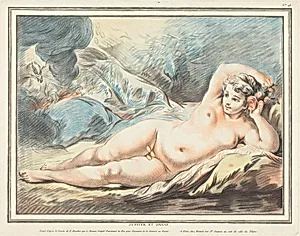
Medium
pastel manner on laid paper
Dimensions
plate: 34.1 x 41.1 cm (13 7/16 x 16 3/16 in.) sheet: 43.5 x 55.7 cm (17 1/8 x 21 15/16 in.)
Classification
Department
CG-E
Museum
National Gallery of Art, Washington, D.C.
Credit
Gift of Ivan E. and Winifred Phillips in memory of Neil Phillips
Accession Number
2005.55.1
Rights
Public Domain
Art Historical Context
In the opulent world of 18th-century French Roc art, *Jupiter and Danaë (1774) captures a timeless mythological tale from Ovid's *Metamorphoses*. Here, the god Jupiter descends upon the mortal princess Danaë in a shower of gold, seducing her in a scene of divine sensuality and luxury. Louis-Marin Bonnet, a master printmaker, created this work after François Boucher, the era's preeminent Rococo painter known for his playful, erotic depictions of classical myths. Boucher's original painting, with its swirling forms and sumptuous colors, exemplifies the movement's delight in pleasure and ornamentation amid the lavish courts of Louis XV. Bonnet's innovation lies in his "pastel manner" technique—a revolutionary print method on laid paper that mimics the soft, velvety texture of pastel drawings. Using colored chalks and precise engraving, he achieved luminous effects unattainable in traditional prints, blending the intimacy of drawing with the reproducibility of prints. Measuring 34.1 x 41.1 cm on the plate, this piece allowed wider dissemination of Boucher's elite imagery to collectors and enthusiasts. Housed in the National Gallery of Art as a gift from Ivan E. and Winifred Phillips, *Jupiter and Danaë* reflects the Enlightenment's fascination with antiquity while showcasing printmaking's democratic potential. Visitors will appreciate its delicate glow, evoking the powdered elegance of Versailles.