
Jupiter en Antiope
c. 1537 - c. 1555
Medium
engraving
Dimensions
170; 130
Rights
Public Domain
About this artwork
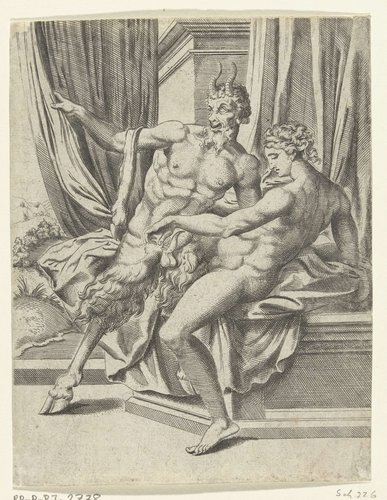
Jupiter, in de gedaante van een sater, verkracht de nimf Antiope. Antiope slaapt, ze heeft haar ogen gesloten. Jupiter trekt een gordijn opzij en komt haar slaapkamer binnen. Prent uit een serie van 10 prenten die het liefdesleven van Jupiter illustreren.
Art Historical Context
Cornelis Bos's *Jupiter en Antiope*, an engraving from around 1537–1555, captures a dramatic moment from classical mythology. Here, the god Jupiter, disguised as a satyr, the sleeping nymph Antiope's bedroom by drawing aside a curtain. With her eyes closed in slumber, Antiope remains unaware, embodying a tale of divine seduction drawn from Ovid's *Metamorphoses*. Measuring just 170mm by 130mm, this intimate print invites close viewing, its fine lines revealing the tension between vulnerability and intrusion. As part of a series of 10 engravings illustrating Jupiter's amorous adventures, the work reflects the Renaissance fascination with classical myths, blending eroticism with moral allegory. Bos, a prominent Antwerp engraver influenced by Italian Renaissance masters, excelled in reproductive prints that made high art accessible. Engraving's precision allowed for intricate details—like the satyr's muscular form and flowing drapery—disseminating such sensual narratives to a wide audience across Europe. This piece highlights the era's cultural embrace of mythological erotica, often collected by elites for private cabinets of curiosities. Its technical mastery underscores prints' role in shaping visual culture during the Northern Renaissance.
About the Artist
Cornelis Bos · 1510–1556
Cornelis Bos (c. 1506/10–before 1555), a Netherlandish engraver, printseller, and publisher born in 's-Hertogenbosch, emerged as a pivotal figure in the Antwerp print trade during the mid-16th century. His early life remains sparsely documented, with no records of formal training or mentors, though he was active in Antwerp by 1537, producing his earliest known engraving, *Prudence and Justice*, af...