
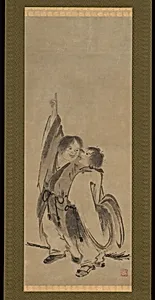
寒山拾得図 (Kanzan Jittoku zu)|Hanshan and Shide
mid- to late 16th century
Medium
Hanging scroll; ink on paper
Dimensions
Image: 36 1/4 × 14 1/2 in. (92.1 × 36.8 cm) Overall with mounting: 72 1/2 × 19 3/4 in. (184.2 × 50.2 cm) Overall with knobs: 72 1/2 × 21 3/4 in. (184.2 × 55.2 cm)
Classification
Paintings
Culture
Japan
Department
Asian Art
Museum
Metropolitan Museum of Art, New York, NY
Credit
Rogers Fund, 1957
Accession Number
57.84
Rights
Public Domain
Tags
Art Historical Context
In the serene tradition of Japanese Zen ink painting, *Hanshan and Shide* (Kanzan Jittoku zu) by the monk-artist Kenkō Shōkei captures two legendary Chinese poet-sages from the Tang dynasty. Hanshan (Kanzan), the ragged mountain hermit, and ShideJittoku), his attendant companion, embody eccentric wisdom and unorthodox enlightenment. Rendered in the mid- to late 16th century during Japan's Muromachi period—a time of civil unrest yet flourishing Zen culture—this hanging scroll reflects the influence of Chinese literati painting on Japanese artists like Shōkei, who trained in temple workshops. Shōkei's masterful use of ink on paper employs bold, expressive brushstrokes to convey spontaneity and spiritual depth, hallmarks of suiboku-ga (water-ink painting). The monumental format (image: 36¼ × 14½ in.) allows figures to emerge dynamically from misty voids, symbolizing the Zen ideals of detachment and humor found in their poetry. Such depictions were cherished in Zen monasteries for meditation and teaching, blending art with philosophy. Acquired through the Rogers Fund in 1957, this Metropolitan Museum of Art treasure invites visitors to ponder timeless themes of simplicity amid chaos, a poignant reminder of Zen's enduring cultural resonance in Japan.
About the Artist
Kenkō Shōkei 賢江祥啓 (Japanese) · 1478 –1523
Japanese, active ca. 1478–ca. 1523