
Karel V, Duits keizer
1556
Medium
casting
Dimensions
17.33; 3.5
Rights
Public Domain
About this artwork
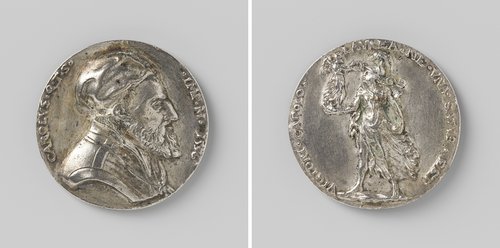
Zilveren penning. Voorzijde: borststuk man binnen omschrift. Keerzijde: gehelmde vrouw houdt Overwinning in haar hand, die haar een lauwerkrans boven hoofd houdt binnen omschrift
Art Historical Context
This exquisite silver medal, struck in 1556 and measuring just 3.5 cm in diameter (17.33 grams), honors Karel V, or Charles V, the Holy Emperor whose vast empire spanned Europe and the Americas during the Renaissance. Cast anonymously, it exemplifies the era's tradition of small-scale commemorative medals—portable artworks blending portraiture, allegory, and propaganda. The obverse features a detailed bust of the emperor within an encircling inscription, capturing his stern visage and imperial authority at a pivotal moment: the year of his abdication, after decades of wars, explorations, and religious strife. On the reverse, a helmeted female figure—likely symbolizing Minerva, goddess of wisdom and war—grasps a winged Victory who crowns her with a laurel wreath, evoking triumph and divine favor. This classical imagery underscores Charles V's military victories, from battles against the Ottomans to the Habsburg-Valois conflicts, while the silver medium highlights Renaissance metallurgy techniques, where casting allowed intricate details on a miniature scale. Such medals were prized by collectors and rulers alike, serving as diplomatic gifts or personal talismans. Today, this piece offers a intimate glimpse into 16th-century power and artistry, reminding us of an emperor who shaped the modern world before retiring to a monastery.
About the Artist
anonymous
In the vast tapestry of art history, "Anonymous" stands not as a singular individual but as a collective designation for countless unidentified creators whose works have endured across millennia. These artists, spanning prehistoric cave painters to medieval illuminators and folk craftsmen, produced the foundational layers of human visual culture. Prior to the Renaissance, when individual fame emer...