
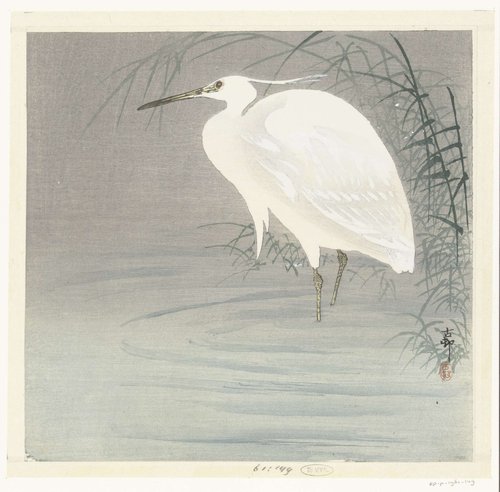
Kleine zilverreiger
1900 - 1930
Medium
color woodcut
Dimensions
242; 250
Rights
Public Domain
About this artwork
Schenking van mevrouw L.J. Boddaert, Delft
Art Historical Context
Ohara Koson’s “leine zilverreiger (Little Egret) captures the quiet elegance of a solitary bird in a moment of stillness. Created between 1900 and 1930, the print exemplifies Koson’s mastery of kacho-e, the traditional Japanese genre of bird-and-flower imagery. Working during the shin-hanga revival, Koson blended centuries-old woodblock methods with a modern sensitivity to naturalistic detail, producing images that feel both precise and poetic. The medium—a color woodcut measuring roughly 24 by 25 centimeters—highlights the technical sophistication of Japanese printmaking. Multiple carved blocks were inked separately and printed in careful registration to achieve soft gradations and delicate plumage textures. Such works were designed for wider appreciation beyond elite circles, allowing nature’s fleeting beauty to enter everyday homes. Donated to the collection by Mrs. L.J. Boddaert of Delft, this modest yet refined print invites viewers to pause and observe the egret’s poised form, reminding us of the enduring appeal of Japanese nature prints in early twentieth-century Europe.
About the Artist
Ohara Koson · 1877–1945
Ohara Koson (1877-1945) was the most successful ukiyo-e artist of the shin-hanga period, renowned for his mastery of kacho-e (bird-and-flower prints). Born in Kanazawa and dying in Tokyo, Koson produced approximately 500 prints during a prolific career that spanned the late Meiji, Taisho, and early Showa periods. His work exemplifies the shin-hanga movement's successful adaptation of traditional J...