
Klänge
1907–12, published 1913
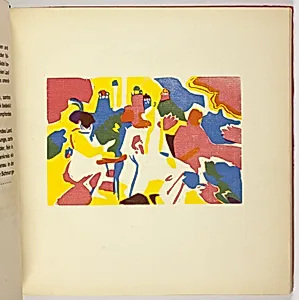
Medium
Book with fifty-six woodcuts, forty-four in black and twelve in color, on cream laid paper
Dimensions
Book, closed: 28.3 × 28.3 × 2 cm (11 3/16 × 11 3/16 × 13/16 in.)
Classification
woodcut
Department
Prints and Drawings
Museum
Art Institute of Chicago
Accession Number
44014
Rights
Public Domain
Art Historical Context
Vasily Kandinsky’s *Klänge* (“Sounds”) is a landmark artist’s book that captures the Russian painter’s pivotal shift toward abstraction in the years before World War I. Created between 1907 and 1912 and published in Munich in 1913, the volume unites fifty-six woodcuts—forty-four printed in black and twelve in color—with Kandinsky’s own prose poems. The square format and hand-printed woodcuts give the pages a rhythmic, musical quality that reflects the artist’s belief in the spiritual correspondence between sound, color, and form. As a founding member of the Blue Rider group, Kandinsky used *Klänge* to explore synesthesia—the idea that colors could evoke sounds and emotions—while challenging traditional distinctions between image and text. The bold, simplified shapes carved into wood allowed him to distill landscapes, figures, and pure abstractions into graphic signs that feel both ancient and modern. Printed on cream laid paper, the book stands as an early twentieth-century experiment in multimedia art. Today *Klänge* is celebrated as one of the first abstract artist’s books, bridging Kandinsky’s earlier folk-inspired woodcuts with the non-objective paintings that would soon define his career. Its compact yet expansive design invites viewers to experience art as an immersive, sensory journey rather than a static object.
About the Artist
Vasily Kandinsky
**Wassily Kandinsky (1866–1944)** was a Russian painter and art theorist widely recognized as one of the pioneers of abstract art in Western painting. Born in Moscow on December 16, 1866, to a tea merchant father and a mother from a noble family with Tatar roots, he initially pursued studies in law and economics before turning to art at age 30. In 1896 he settled in Munich, where he trained first ...