
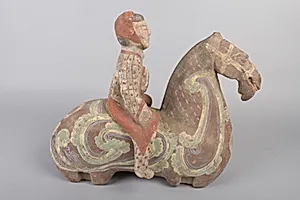
Kneeling Horse and Separately Modeled Rider
Unknown Artist
3200 BCE–1644 CE
Medium
Grey earthenware
Dimensions
Horse: H. 13 1/2 in. (34.3 cm); L. 18 11/16 in. (47.5 cm) Rider: H. 13 in. (33 cm); W. 9 3/4 in. (24.8 cm)
Classification
Ceramics
Culture & Period
China · Neolithic period to Ming dynasty (1368–1644)
Department
Asian Art
Museum
Metropolitan Museum of Art, New York, NY
Credit
Charlotte C. and John C. Weber Collection, Gift of Charlotte C. and John C. Weber, 1994
Accession Number
1994.605.110a, b
Rights
Public Domain
Tags
Art Historical Context
This captivating grey earthenware sculpture, *Kneeling Horse and Separ Modeled Rider*, hails from ancient China and spans an astonishing timeline from the Neolithic period (around 3200 BCE) to the Ming dynasty (136–1644 CE). at about 13 inches tall, the horse measures 18½ inches long, with its rider crafted separately for intricate detailing. Housed in the Metropolitan Museum of Art's Art Department as part of the Charlotte C and John C. Weber, this piece exemplifies the enduring tradition of Chinese ceramics, where unglazed earthenware was fired to create durable, expressive forms. The broad date range reflects the longevity of horse-and-rider motifs in Chinese art, symbolizing power, mobility, and status—evident in the tags highlighting "Men" and "Horses." Grey earthenware, a staple medium from early dynasties, allowed artisans to capture naturalistic poses, like the horse's kneeling stance, possibly evoking readiness for mounting or ritual purposes. The separate modeling of the rider highlights advanced ceramic techniques, enabling lifelike proportions and subtle gestures. Culturally, such figures often served in tombs as mingqi, or spirit objects, accompanying the deceased into the afterlife across millennia. This artifact invites us to ponder China's rich ceramic heritage, bridging prehistoric simplicity with imperial sophistication.