
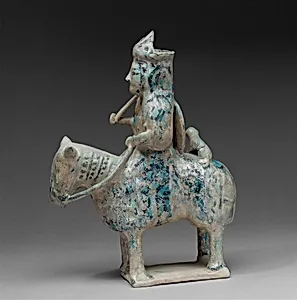
Mounted Hunter with Cheetah
Unknown Artist
12th–early 13th century
Medium
Stonepaste; molded in sections, glazed in transparent turquoise, underglaze-painted in black
Dimensions
H. 10 7/8 in. (27.6 cm) W. 3 in. (7.6 cm) D. 8 1/4 in. (21 cm) Wt. 24 oz (680.5 g)
Classification
Ceramics
Department
Islamic Art
Museum
Metropolitan Museum of Art, New York, NY
Credit
Harris Brisbane Dick Fund, 1966
Accession Number
66.23
Rights
Public Domain
Tags
Art Historical Context
This exquisite ceramic figurine, *Mounted Hunter with Cheetah hails from the Islamic world of the 12th to early 13th century, a golden age of artistic innovation in regions like Persia (modern-day Iran). Crafted from stonepaste—a composite of quartz, clay, and frit developed by Islamic potters to mimic the durability and translucency of Chinese porcelain stands just under 11 inches tall. The figure depicts a dynamic rider on horseback, accompanied by a sleek cheetah, a symbol of elite falconry and hunting traditions favored by nobility and rulers. The artwork's medium showcases masterful techniques: molded in sections for intricate details, then glazed in vibrant turquoise and underglaze-painted in black for sharp contrasts. This method, prominent in centers like Kashan, allowed for lively three-dimensional storytelling on small scales, blending functionality with artistry. Cheetahs, tamed for hunting gazelle, reflect the cultural prestige of such pursuits in medieval Islamic courts, evoking tales from Persian literature like the *Shahnameh*. Now in the Metropolitan Museum of Art's Islamic Art Department (acquired via the Harris Brisbane Dick Fund in 1966), this piece offers a glimpse into everyday grandeur, inviting visitors to imagine the thrill of the hunt across vast steppes.