
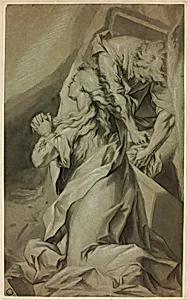
Kneeling Magdalene and Tomb Attendant
n.d.
Medium
Black chalk and brush and black and gray wash, heightened with touches of white chalk, on gray-green laid paper, laid down on tan wove paper, drum mounted on ivory wove paper
Dimensions
41 × 25.1 cm (16 3/16 × 9 15/16 in.)
Classification
chalk and wash
Department
Prints and Drawings
Museum
Art Institute of Chicago
Accession Number
84140
Rights
Public Domain
Art Historical Context
Federico Barocci (1528–1612), a masterful Italian artist from Urbino, bridges Mannerism and the emerging Baroque with his tender, emotive style. This drawing, *Kneeling Magdalene and Tomb Attendant*, captures a poignant biblical moment—likely from the Entombment of Christ—where the grieving Mary Magdalene kneels beside a tomb attendant. Barocci's preparatory sketches like this one were treasured in his time for their lyrical grace and psychological depth, reflecting Counter-Reformation ideals of spiritual intimacy. Executed in black chalk, brush with black and gray wash, and heightened with white chalk on gray-green laid paper, the work exemplifies 16th-century draftsmanship. The tinted paper serves as a mid-tone, allowing Barocci to model forms through subtle chiaroscuro, evoking soft, diffused light that bathes the figures in gentle pathos. This mixed-media technique, later mounted for preservation, showcases his innovative approach, blending drawing's precision with painting's fluidity. Housed in the Art Institute of Chicago's Prints and Drawings Department, this 41 × 25.1 cm study highlights Barocci's influence on artists like Rubens and Caravaggio. It invites visitors to appreciate the quiet drama of devotion, a window into Renaissance workshop creativity where sketches often rivaled finished oils in expressive power.
About the Artist
Federico Barocci · 1535–1612
Federico Barocci (c. 1535–1612) was an Italian painter from Urbino whose luminous, emotionally tender religious paintings made him one of the most original and influential artists of the late sixteenth century, bridging Mannerism and the early Baroque. Born in Urbino, the city of Raphael, he studied under Battista Franco and traveled to Rome, where he absorbed the lessons of Raphael, Correggio, an...