
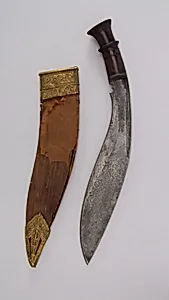
Knife (Kukri) with Sheath
Unknown Artist
19th century
Medium
Steel, wood, leather, gold
Dimensions
H. with sheath 17 7/16 in. (44.3 cm); H. without sheath 16 5/8 in. (42.2 cm); W. 1 15/16 in. (4.9 cm); Wt. 1 lb. 1.2 oz. (487.6 g); Wt. of sheath 5.1 oz. (144.6 g)
Classification
Knives
Culture
Indian or Nepalese, Gurkha
Department
Arms and Armor
Museum
Metropolitan Museum of Art, New York, NY
Credit
Bequest of George C. Stone, 1935
Accession Number
36.25.825a, b
Rights
Public Domain
Art Historical Context
This formidable **Knife (Kukri) with Sheath** from the19th century exemplifies the iconic weaponry of the Gurkha people, hailing from Nepal or northern India. Measuring 17 7/16 inches with its sheath, this steel-bladed knife features a distinctive inward-curving edge designed for powerful chopping and slashing motions, making it both a practical tool and a fearsome combat weapon. Crafted by an unknown artisan, it weighs just over a pound, balancing lethality with portability for the legendary Gurkha soldiers, whose bravery in battles from the Anglo-Nepalese Wars to World War II earned them enduring fame. The kukri holds profound cultural significance beyond its martial role, symbolizing Gurkha identity, honor, and craftsmanship. Often carried by every Gurkha warrior, it was used for everything from clearing brush to ritual ceremonies, embodying a warrior ethos passed down through generations. The sheath, adorned with wood, leather, and touches of gold, highlights decorative artistry, where gold inlays might signify status or protection. Housed in the Metropolitan Museum of Art's Arms and Armor Department through the 1935 bequest of George C. Stone, this piece invites visitors to appreciate how functional objects like the kukri blend utility, symbolism, and exquisite handiwork into living history.