
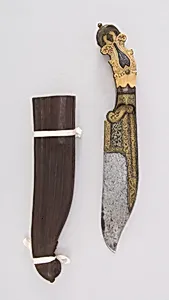
Knife (Piha Kaetta) with Sheath
Unknown Artist
18th–19th century
Medium
Ivory, silver, brass
Dimensions
H. with sheath 14 in. (35.6 cm); H. without sheath 12 3/4 in. (32.4 cm); W. 2 1/4 in. (5.7 cm); Wt. 1 lb. 6.9 oz. (649.2 g); Wt. of sheath 3.4 oz. (96.4 g)
Classification
Knives
Culture
Sri Lankan
Department
Arms and Armor
Museum
Metropolitan Museum of Art, New York, NY
Credit
Bequest of George C. Stone, 1935
Accession Number
36.25.961a, b
Rights
Public Domain
Art Historical Context
This exquisite *Piha Kaetta* knife with sheath, hailing from Sri Lanka in the 18 or 19th century, exemplifies the fusion of utility and artistry in South Asian arms. Measuring 14 inches tall with its sheath and weighing a substantial 1 pound 6.9 ounces, the blade and fittings are crafted from ivory, silver, and brass—luxurious materials that elevate it beyond a mere weapon into a status symbol. Displayed in the Metropolitan Museum of Art's Arms and Armor department, it reflects the skilled workmanship of an unknown artisan during a period of Sri Lankan cultural flourishing under the Kandyan Kingdom. The *Piha Kaetta*, a traditional Sinhalese fighting dagger, features a curved blade suited for close combat, paired with an ornate hilt often carved from ivory for ergonomic grip and aesthetic appeal. Silver and brass accents likely added decorative filigree or inlays, common in elite weaponry, blending practicality with ornamental beauty. Such knives held cultural significance as heirlooms or ceremonial objects, embodying martial prowess and social prestige. Bequeathed to the Met in 1935 by George C. Stone, this piece invites visitors to ponder how everyday tools of defense became canvases for cultural expression, bridging history and craftsmanship in Sri Lanka's enduring legacy.