
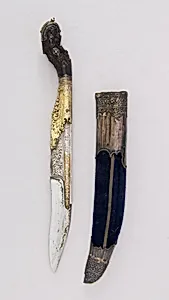
Knife (Piha Kaetta) with Sheath
Unknown Artist
18th–19th century
Medium
Brass, silver
Dimensions
H. with sheath 11 5/8 in. (29.5 cm); H. without sheath 11 1/4 in. (28.6 cm); W. 1 3/8 in. (3.5 cm); Wt. 7.2 oz. (204.1 g); Wt. of sheath 2.2 oz. (62.4 g)
Classification
Knives
Culture
Sri Lankan
Department
Arms and Armor
Museum
Metropolitan Museum of Art, New York, NY
Credit
Bequest of George C. Stone, 1935
Accession Number
36.25.963a, b
Rights
Public Domain
Art Historical Context
This exquisite **Knife (Piha Kaetta) with Sheath**, crafted by an unknown Sri Lankan artisan in the 18th–19th century, exemplifies the's masterful metalworking traditions. Measuring 11⅝ inches with its sheath, the dagger features a brass blade and silver accents, weighing a balanced 7.2 ounces—ideal for both utility and combat. Housed in the Metropolitan Museum of Art's Arms Armor Department (Bequest of George C., 1935), it showcases the Piha Kaetta's distinctive form: a broad, curving blade designed for close-quarters fighting, paired with an ergonomic handle that fits the hand like a natural extension. In Sri Lankan culture, such knives held profound significance beyond weaponry. During the Kandyan Kingdom era and amid colonial pressures from Portuguese, Dutch, and British forces, the Piha Kaetta symbolized martial prowess and craftsmanship. Brass provided durability and a golden sheen, while silver added prestige through intricate chasing or inlays, reflecting techniques honed over generations. These pieces often served ceremonial roles in rituals or as status symbols for warriors. Today, this artifact invites us to ponder Sri Lanka's resilient heritage, blending lethal function with artistic elegance. A testament to anonymous skill, it bridges history's violent chapters with enduring beauty.