
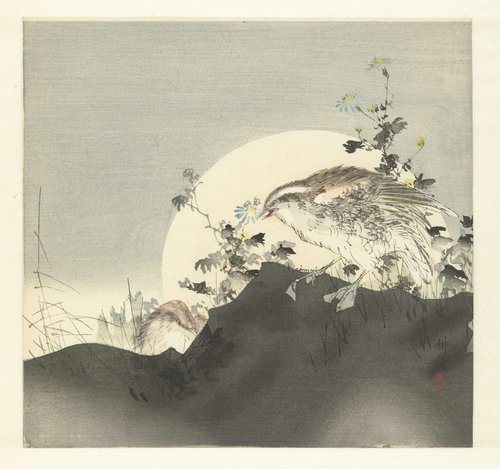
Kwartels
1890 - 1900
Medium
color woodcut
Dimensions
239; 250
Rights
Public Domain
About this artwork
blad: hoogte 250 mm (shikishiban) x breedte 239 mm
Art Historical Context
Tsukioka Kôgyo’s “Kwartels” captures a quiet moment of natural beauty through the delicate medium of color woodcut. Created between 1890 and 1900, this shikishiban print measures just 250 by 239 millimeters, a compact square format often favored for intimate, refined compositions. Kôgyo, active during Japan’s Meiji era, was renowned for his sensitive depictions of birds, flowers, and theatrical subjects, continuing the rich traditions of ukiyo-e while adapting to modern tastes. The color woodcut technique highlights the artist’s mastery of layered printing. Multiple carved blocks, each inked with a different hue, produce the soft gradations and fine details that bring the quails to life against their setting. Such prints were prized both in Japan and abroad, reflecting a growing international appreciation for Japanese art during this period. As a small-scale work, “Kwartels” invites close viewing, rewarding museum visitors with its elegant balance of simplicity and precision. It stands as a charming example of late nineteenth-century Japanese printmaking, where everyday subjects like birds were elevated to objects of quiet contemplation and artistic refinement.
About the Artist
Tsukioka Kôgyo · 1869–1927
Tsukioka Kōgyo (1869–1927), born Hanyū Bennosuke in Tokyo's bustling Nihonbashi district as the second son of an innkeeper family, navigated a path from humble origins to mastery in Japanese printmaking. After his father's early death, he was raised by his mother's Sakamaki family and apprenticed in pottery painting under his uncle, a ceramics exporter in Yokohama. He briefly attended the Tokyo Sc...