
L'Heureuse Fecondite
Medium
Etching, second state
Dimensions
sheet: 15 1/2 x 21 1/4 in. (39.3 x 54 cm) image: 10 9/16 x 12 in. (26.9 x 30.5 cm)
Classification
Prints
Department
Drawings and Prints
Museum
Metropolitan Museum of Art, New York, NY
Credit
Purchase, Roland L. Redmond Gift, Louis V. Bell and Rogers Funds, 1972
Accession Number
1972.539.15
Rights
Public Domain
Tags
Art Historical Context
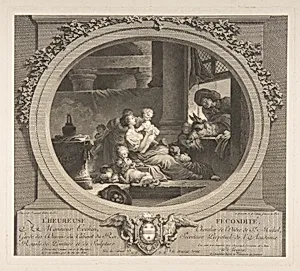
**L'Heureuse Fecondite (The Happy Fecund)** Created by the celebrated Rococo master Jean Honoré Fragon and engraved by Nicolas de Launay this undated etching captures the exuberant spirit of 18th-century decorative arts. Fragonard, known for his playful, sensual scenes filled with swirling forms and lush details, designed the composition, while Launay's skilled etching brought it to life in its second state—a refined edition with enhanced lines and tonal depth. Measuring about 10½ by 12 inches in the image area, the print exemplifies how Rococo artists used printmaking to share intimate, aristocratic fantasies with a wider audience. The title evokes themes of joyful fertility, featuring women, infants, dogs, and animals amid a coat of arms, suggesting an allegorical celebration of family prosperity and noble lineage. These motifs reflect the era's fascination with domestic bliss and abundance, often idealized in opulent estates. Etching's fine lines allowed for the intricate textures of fabrics, fur, and foliage that define Fragonard's style, blending whimsy with elegance. Housed in the Metropolitan Museum of Art's Drawings and Prints department, this work highlights the collaborative brilliance of painting and printmaking in Rococo France, offering visitors a window into a world of lavish indulgence and harmonious life. (198 words)
About the Artist
Jean Honoré Fragonard|Nicolas de Launay · 1732–1806
Jean-Honoré Fragonard (1732-1806) was a French painter and printmaker whose late Rococo manner was distinguished by remarkable facility, exuberance, and hedonism. Born in Grasse, he moved to Paris where he trained under Jean-Baptiste Chardin and François Boucher, winning the prestigious Prix de Rome in 1752. After studying in Italy alongside Hubert Robert, Fragonard returned to Paris in 1761 to fi...